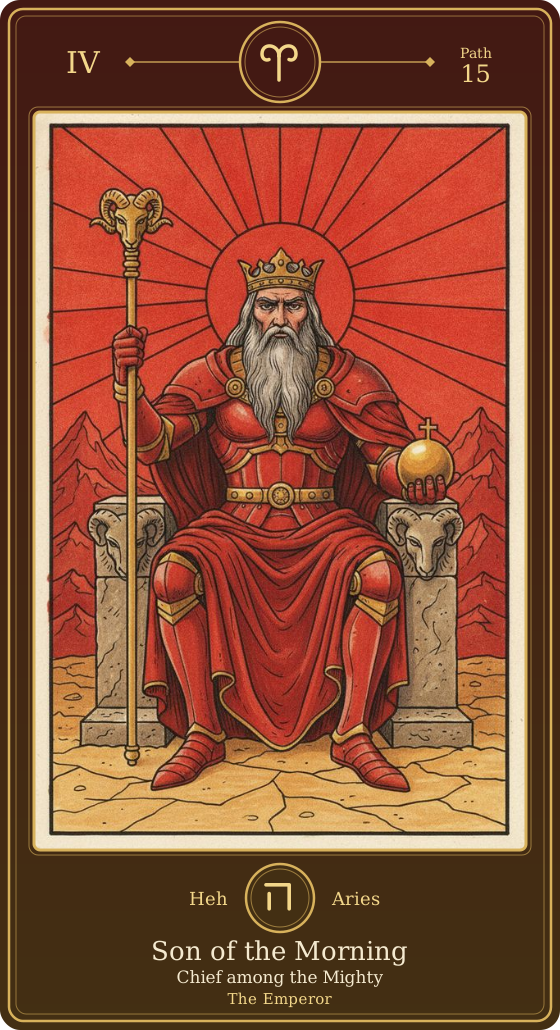
Book T no. 61 · Key 4 · Hebrew letter Heh · Path 15
Son of the Morning, chief among the Mighty
The Emperor (Key 4) · Son of the Morning, chief among the Mighty
Read to know yourself, not to surrender yourself: relate to the card; never obey it.
Book T (1912)
War, conquest, victory, strife, ambition.
Book T as printed in The Equinox I(8), 1912, public domain (notes in square brackets are Crowley's).
In Book T's table
No. 61 of Book T's 78 titles · The Emperor, Key 4 · letter ה Heh · Aries
Correspondences
Hebrew letter: ה (Heh, 'window') — path 15 on the Tree of Life.
On the Tree: path 15 joins Chokmah and Tiphareth · see it on the map
Attribution: Aries.
(Classical Golden Dawn / Book T attribution. Modern decks add an outer planet — Uranus, Neptune, or Pluto — to the three elemental trumps.)
Waite, Pictorial Key (1911)
A. E. Waite, a member of the Golden Dawn, in The Pictorial Key to the Tarot (London, 1911) · public domain · he describes the Rider-Waite-Smith picture of this card, not Book T's
He has a form of the Crux ansata for his sceptre and a globe in his left hand. He is a crowned monarch— commanding, stately, seated on a throne, the arms of which are fronted by rams' heads. He is executive and realization, the power of this world, here clothed with the highest of its natural attributes. He is occasionally represented as seated on a cubic stone, which, however, confuses some of the issues. He is the virile power, to which the Empress responds, and in this sense is he who seeks to remove the Veil of Isis; yet she remains virgo intacta.
It should be understood that this card and that of the Empress do not precisely represent the condition of married life, though this state is implied. On the surface, as I have indicated, they stand for mundane royalty, uplifted on the seats of the mighty; but above this there is the suggestion of another presence. They signify also— and the male figure especially-the higher kingship, occupying the intellectual throne. Hereof is the lordship of thought rather than of the animal world. Both personalities, after their own manner, are "full of strange experience," but theirs is not consciously the wisdom which draws from a higher world. The Emperor has been described as (a) will in its embodied form, but this is only one of its applications, and (b) as an expression of virtualities contained in the Absolute Being— but this is fantasy.
Case, Introduction to the Tarot (1920)
Paul Foster Case, in An Introduction to the Study of the Tarot (New York, 1920), Chapter III, on the letter Heh · public domain in the US · the whole booklet
Window: admits light and air; gives outlook.
Sight: vision, contemplation, discernment.
North-East: combines North (Peh) and East (Daleth) ; opposite of South-west (Nun) ; complement of South-east (Vau).
> Note 4. The planetary attributions are from Book 777, London, 1909.
Aries: diurnal house of Mars (Peh) ; complement of Scorpio (Nun), the nocturnal house. Constituting Intelligence: To constitute is to make anything what it is, to frame, to compose; this path joins Chokmah to Tiphareth.
Picture sets
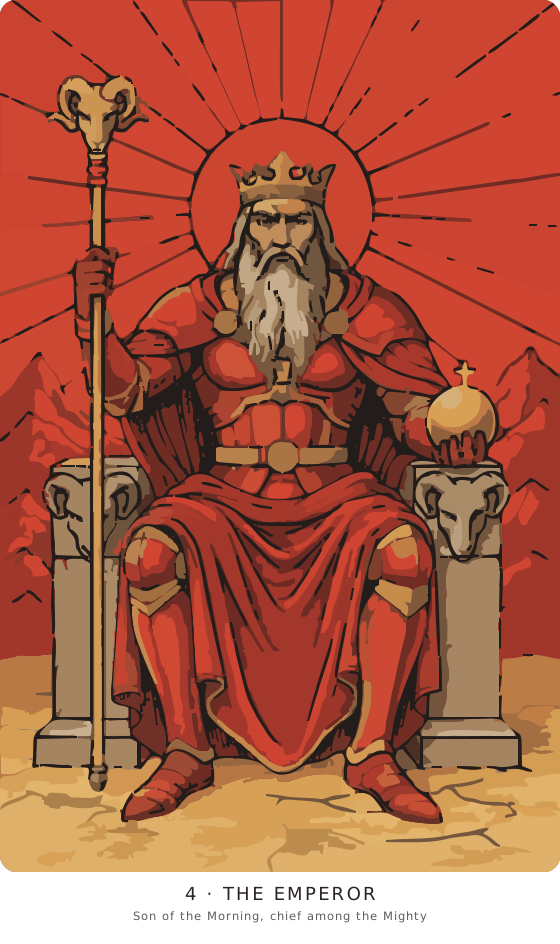 Book T deck, SVG. PlayfulProcess (line art traced from the AI painting). CC-BY-SA-4.0.
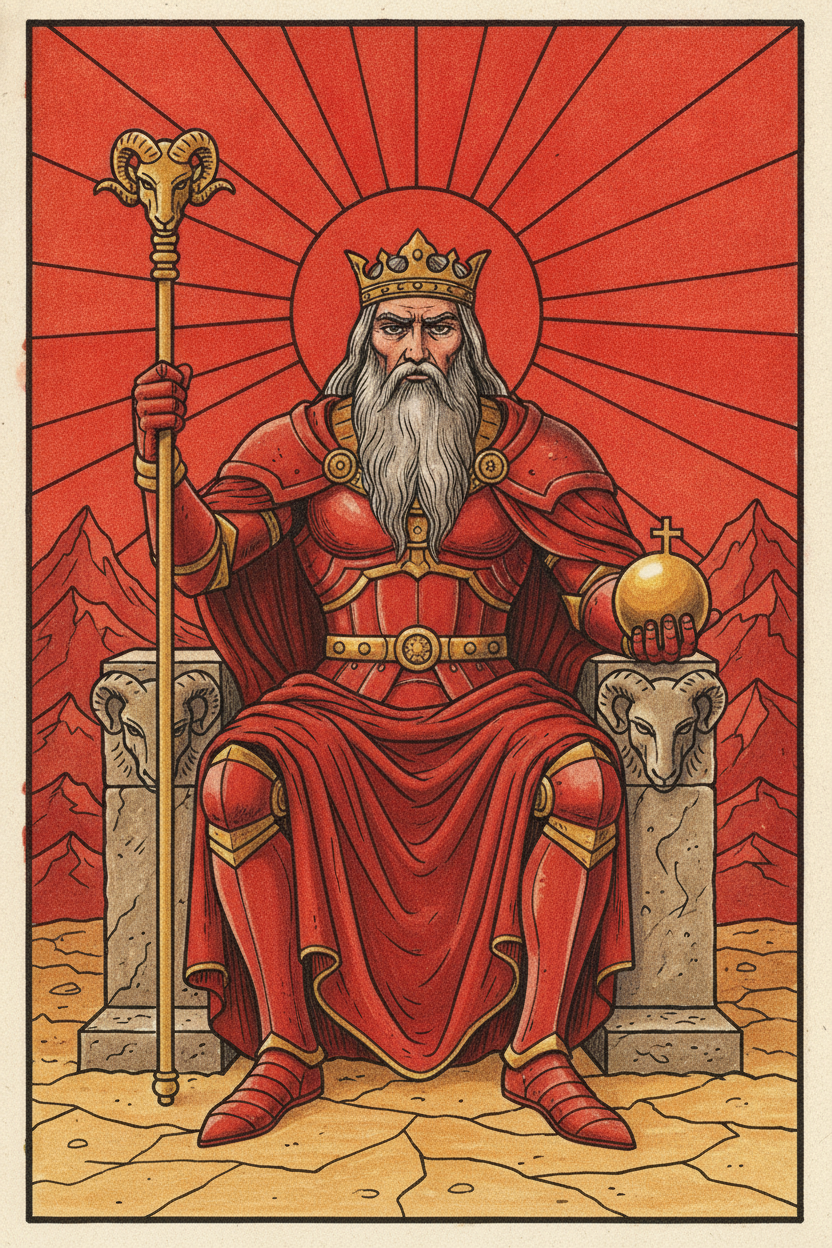 Book T deck, painting. AI painting (gemini-2.5-flash-image) from Book T's words, prompt by PlayfulProcess. CC-BY-SA-4.0.
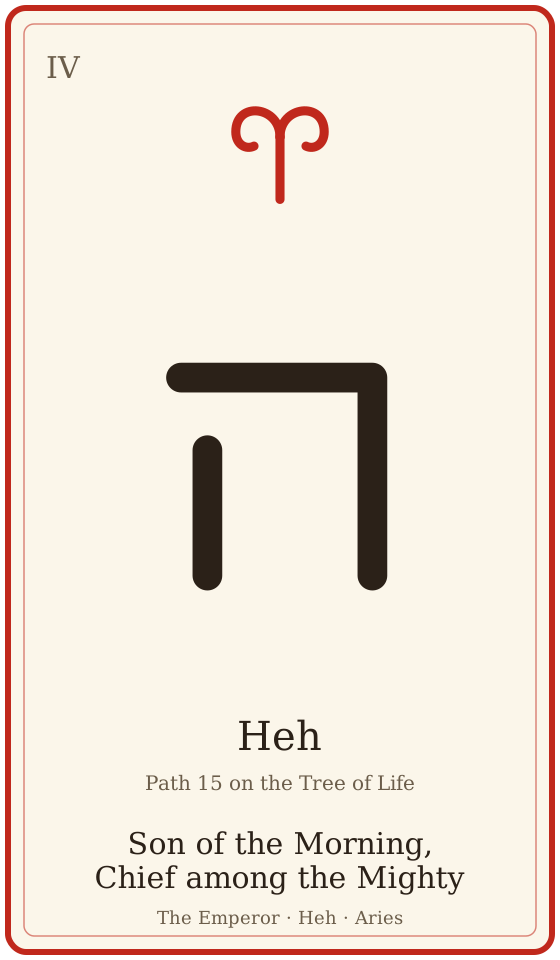 Book T deck, iconography. PlayfulProcess: glyphs drawn for this deck, composed by script (scripts/build_book_t_iconography.py) from the card's own metadata, placed as Book T (1912) places them. CC-BY-SA-4.0.
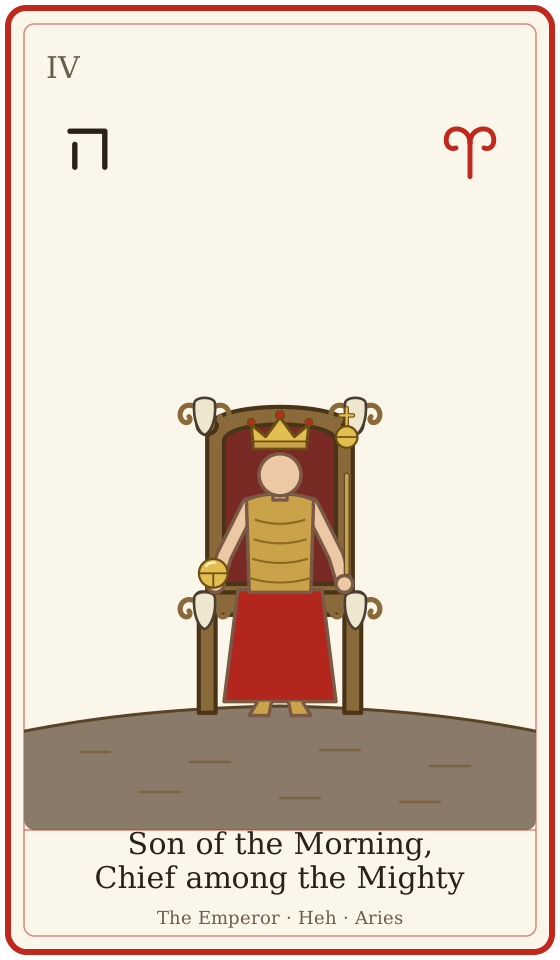 Book T deck, full imagery. PlayfulProcess: parts drawn for this deck (tarot/book-t/parts, tarot/book-t/glyphs), composed by script (scripts/build_book_t_full_imagery.py) from a spec per card that follows Book T (1912). CC-BY-SA-4.0.
 Book T deck, linocut. PlayfulProcess: a linocut printing of the full imagery, composed by script (scripts/build_book_t_linocut.py) from the same spec per card, which follows Book T (1912). CC-BY-SA-4.0.