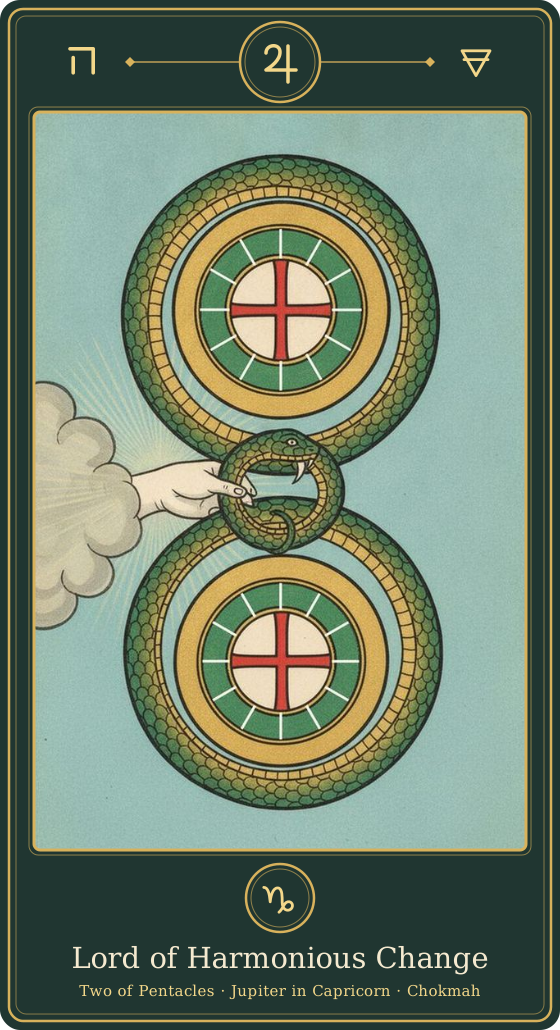
Book T no. 36 · Two of Pentacles · decan: Jupiter in Capricorn
Lord of Harmonious Change
Two of Pentacles · Lord of Harmonious Change
Read to know yourself, not to surrender yourself: relate to the card; never obey it.
Book T (1912)
TWO wheels, disks or pentacles, similar to that of the Ace. They are united by a green-and-gold serpent, bound about them like a figure of 8. It holds its tail in its mouth. A White Radiant Angelic Hand holds the centre of the whole. No roses enter into this card. Above and below are the symbols of Jupiter and Capricorn. It is a revolving symbol.
The harmony of change, alternation of gain and loss; weakness and strength; everchanging occupation; wandering, discontented with any fixed condition of things; now elated, then melancholy; industrious, yet unreliable; fortunate through prudence of management, yet sometimes unaccountably foolish; alternatively talkative and suspicious. Kind, yet wavering and inconsistent. Fortunate in journeying. Argumentative.
Chokmah of ה (Pleasant change, visit to friends).
Herein the Angels לכבאל and ושריה have rule.
Book T as printed in The Equinox I(8), 1912, public domain (notes in square brackets are Crowley's).
In Book T's table
No. 36 of Book T's 78 titles · Two of Pentacles · decan: Jupiter in Capricorn
Correspondences
Waite, Pictorial Key (1911)
A. E. Waite, a member of the Golden Dawn, in The Pictorial Key to the Tarot (London, 1911) · public domain · he describes the Rider-Waite-Smith picture of this card, not Book T's
A young man, in the act of dancing, has a pentacle in either hand, and they are joined by that endless cord which is like the number 8 reversed. Divinatory Meanings : On the one hand it is represented as a card of gaiety, recreation and its connexions, which is the subject of the design; but it is read also as news and messages in writing, as obstacles, agitation, trouble, embroilment. Reversed : Enforced gaiety, simulated enjoyment, literal sense, handwriting, composition, letters of exchange.
Picture sets
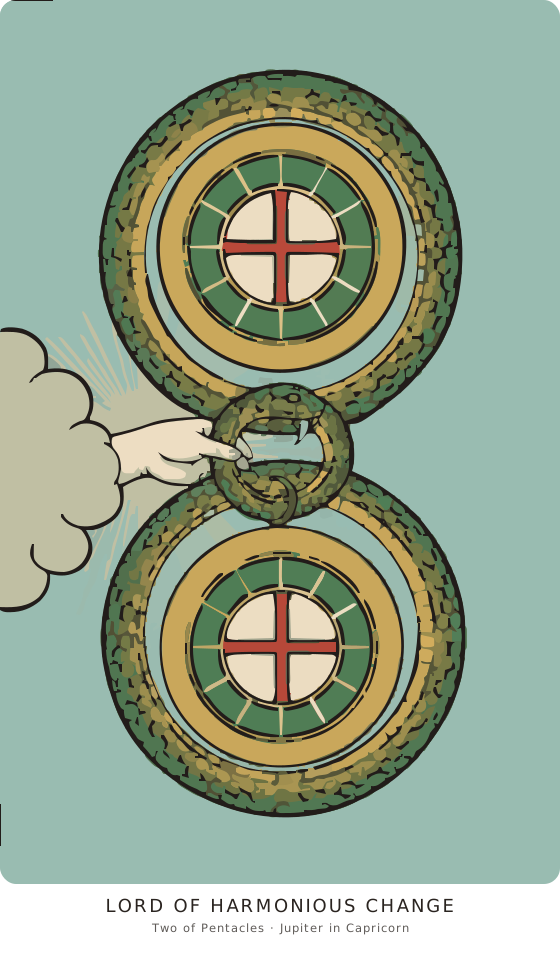 Book T deck, SVG. PlayfulProcess (line art traced from the AI painting). CC-BY-SA-4.0.
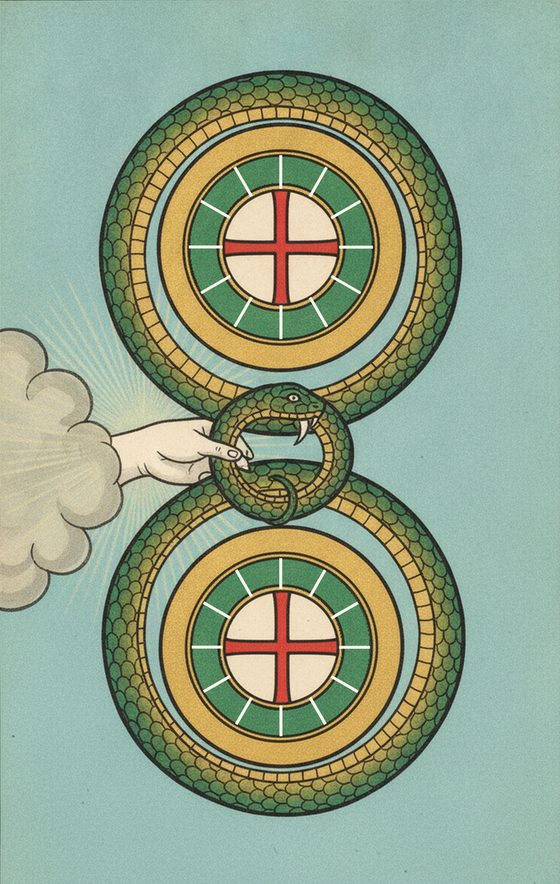 Book T deck, painting (corrected). AI painting (gemini-2.5-flash-image) from Book T's words, prompt by PlayfulProcess; twelve rays added to each disc by PlayfulProcess, as on the Ace. CC-BY-SA-4.0.
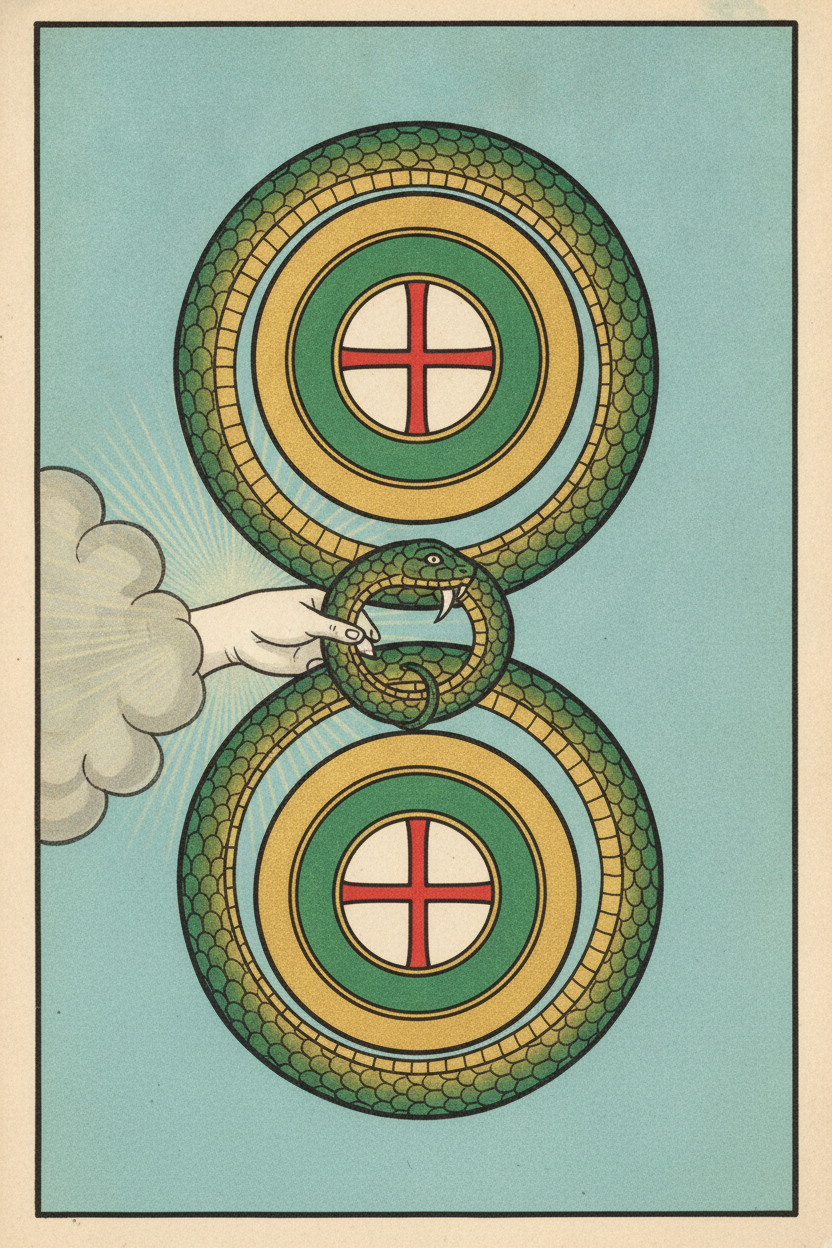 Book T deck, painting as generated. AI painting (gemini-2.5-flash-image) from Book T's words, prompt by PlayfulProcess. CC-BY-SA-4.0.
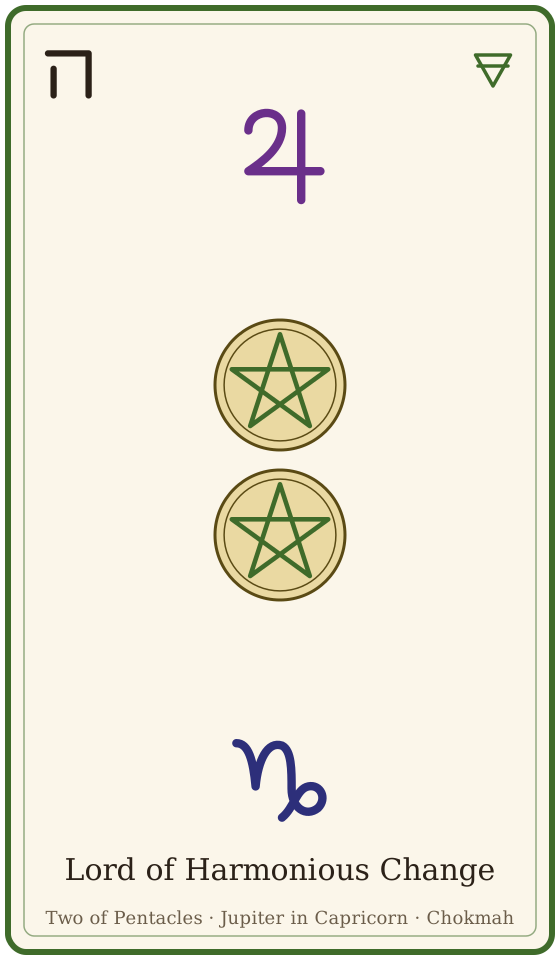 Book T deck, iconography. PlayfulProcess: glyphs drawn for this deck, composed by script (scripts/build_book_t_iconography.py) from the card's own metadata, placed as Book T (1912) places them. CC-BY-SA-4.0.
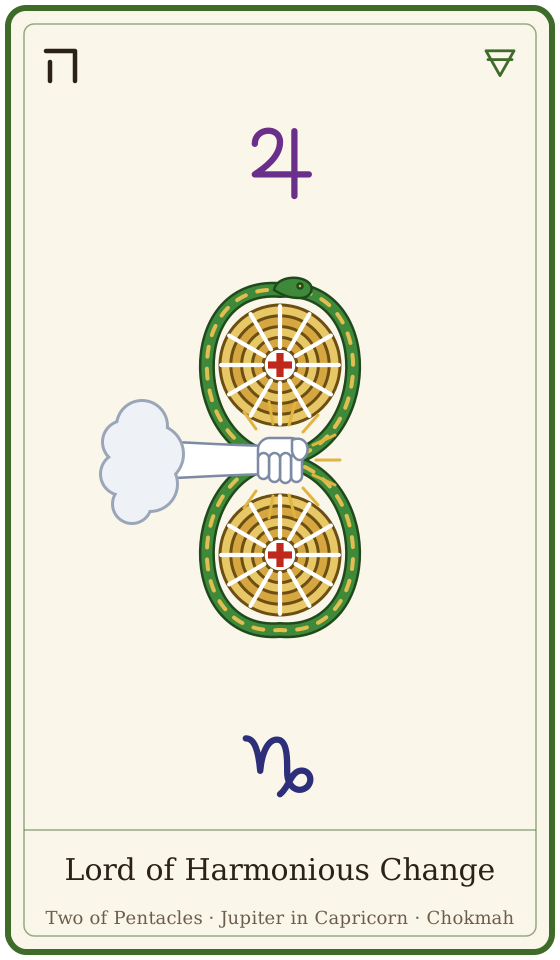 Book T deck, full imagery. PlayfulProcess: parts drawn for this deck (tarot/book-t/parts, tarot/book-t/glyphs), composed by script (scripts/build_book_t_full_imagery.py) from a spec per card that follows Book T (1912). CC-BY-SA-4.0.
 Book T deck, linocut. PlayfulProcess: a linocut printing of the full imagery, composed by script (scripts/build_book_t_linocut.py) from the same spec per card, which follows Book T (1912). CC-BY-SA-4.0.