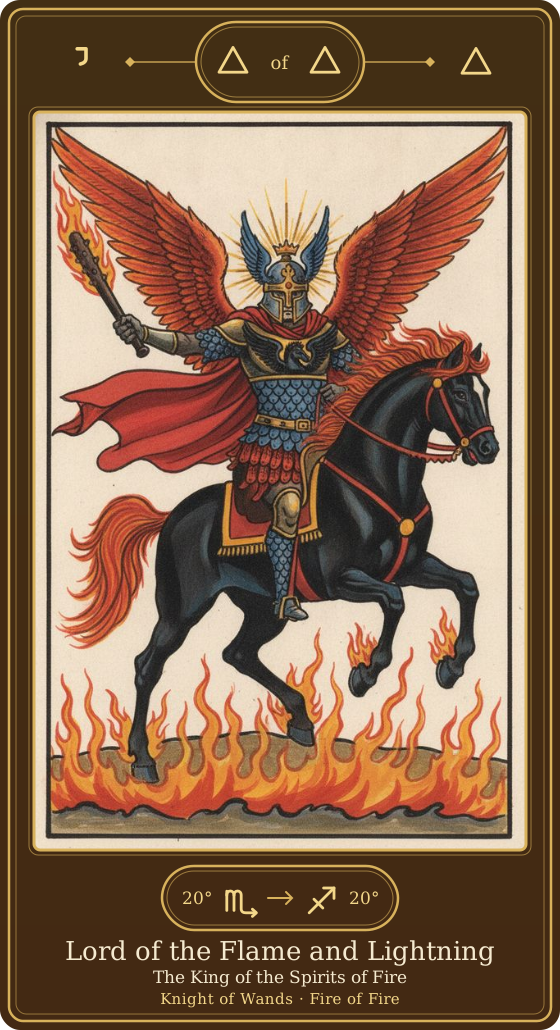
Book T no. 5 · Knight of Wands · Fire of Fire
Lord of the Flame and Lightning: the King of the Spirits of Fire
Knight of Wands · The Lord of the Flame and Lightning: the King of the Spirits of Fire
Read to know yourself, not to surrender yourself: relate to the card; never obey it.
Book T (1912)
Note that the Kings are now called Knights, and the Princes are now called Kings. This is unfortunate, and leads to confusion; the Princes may be called Emperors without harm. Remember only that the horsed figures refer to the Yod of Tetragrammaton, the charioted figures to the Vau.
A WINGED Warrior riding upon a black horse with flaming mane and tail: the horse itself is not winged. The rider wears a winged helmet (like the old Scandinavian and Gaulish helmet) with a Rayed Crown, a corslet of scale-mail and buskins of the same, and a flowing scarlet mantle. Above his helmet, upon his curass, and on the shoulder-pieces and buskins, he wears as a crest a winged black horse's head. He grasps a club with flaming ends, somewhat similar to that in the symbol of the Ace of Wands, but not so heavy, and also the sigil of his scale is shown; beneath the rushing feet of his steed are waving flames and fire. He is active — generous — fierce — sudden — impetuous.
He rules the celestial heavens from above the Twentieth Degree of Scorpio to the First Two Decans of Sagittarius: and this includes a part of the Constellation Hercules. (Hercules is always represented with a Club.)
Fire of Fire
King of the Salamanders.
Book T as printed in The Equinox I(8), 1912, public domain (notes in square brackets are Crowley's).
If ill dignified
Book T (1912): its words for the card when it falls ill dignified, set apart from its text
If ill dignified, he is evil-minded — cruel — bigoted — brutal.
In Book T's table
No. 5 of Book T's 78 titles · Knight of Wands · Fire of Fire
Correspondences
Rules 20° Scorpio – 20° Sagittarius. As Fire of Fire, this court is the fire aspect of an ardent and swift suit.
Waite, Pictorial Key (1911)
A. E. Waite, a member of the Golden Dawn, in The Pictorial Key to the Tarot (London, 1911) · public domain · he describes the Rider-Waite-Smith picture of this card, not Book T's
He is shewn as if upon a journey, armed with a short wand, and although mailed is not on a warlike errand. He is passing mounds or pyramids. The motion of the horse is a key to the character of its rider, and suggests the precipitate mood, or things connected therewith. Divinatory Meanings : Departure, absence, flight, emigration. A dark young man, friendly. Change of residence. Reversed : Rupture, division, interruption, discord,
Picture sets
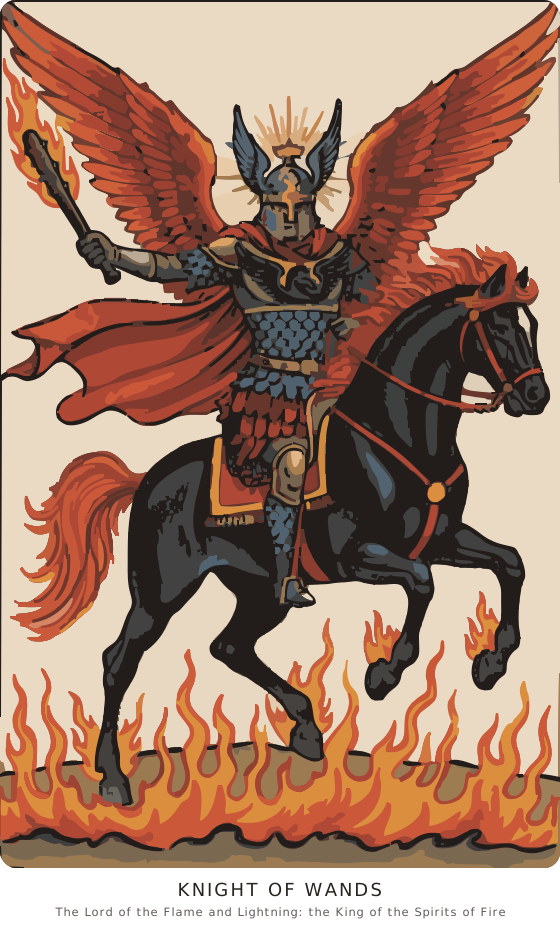 Book T deck, SVG. PlayfulProcess (line art traced from the AI painting). CC-BY-SA-4.0.
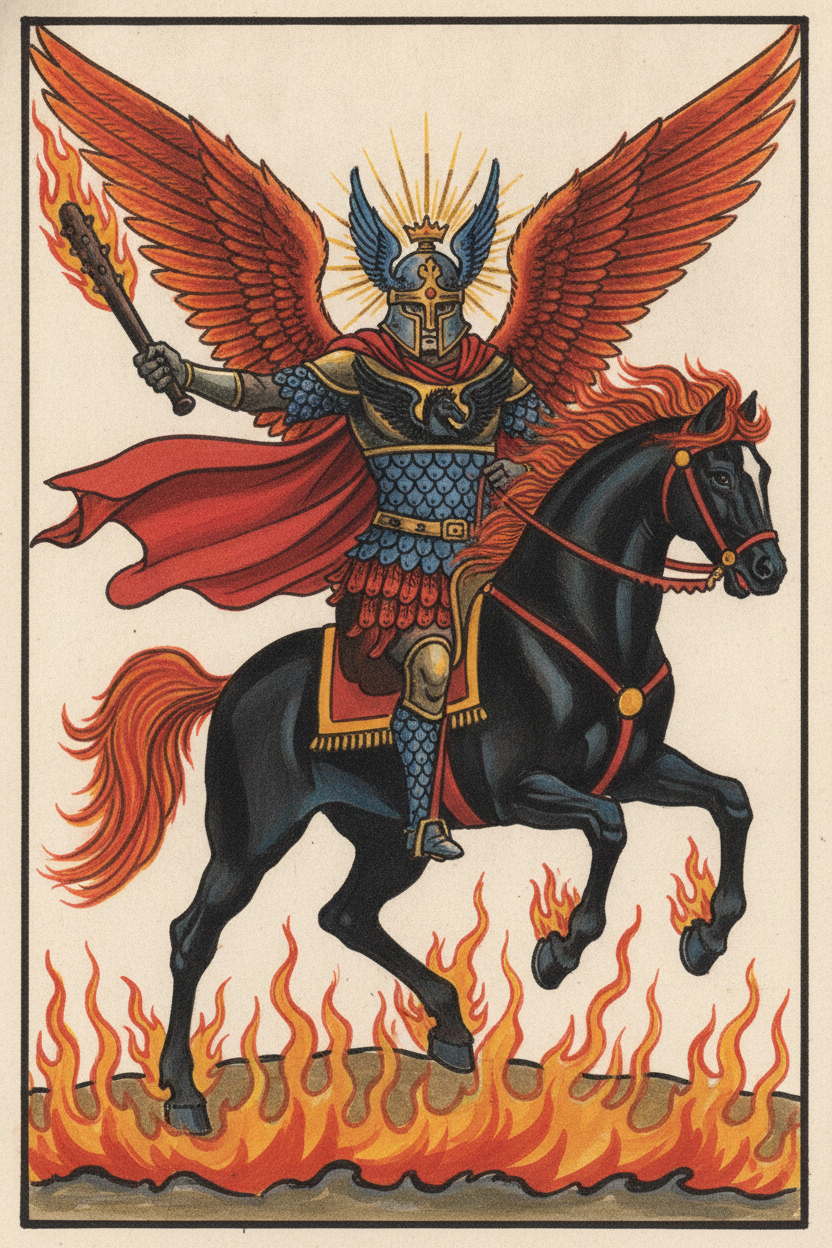 Book T deck, painting. AI painting (gemini-2.5-flash-image) from Book T's words, prompt by PlayfulProcess. CC-BY-SA-4.0.
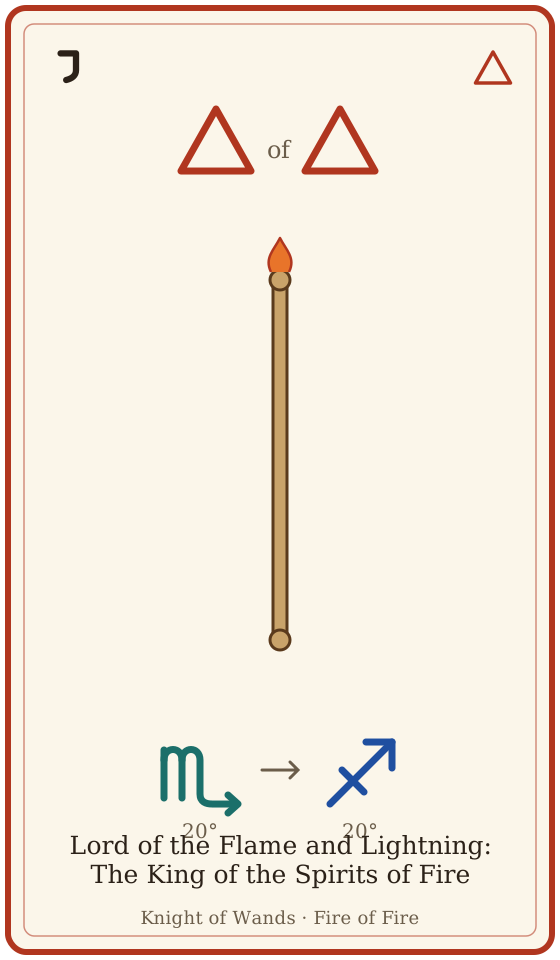 Book T deck, iconography. PlayfulProcess: glyphs drawn for this deck, composed by script (scripts/build_book_t_iconography.py) from the card's own metadata, placed as Book T (1912) places them. CC-BY-SA-4.0.
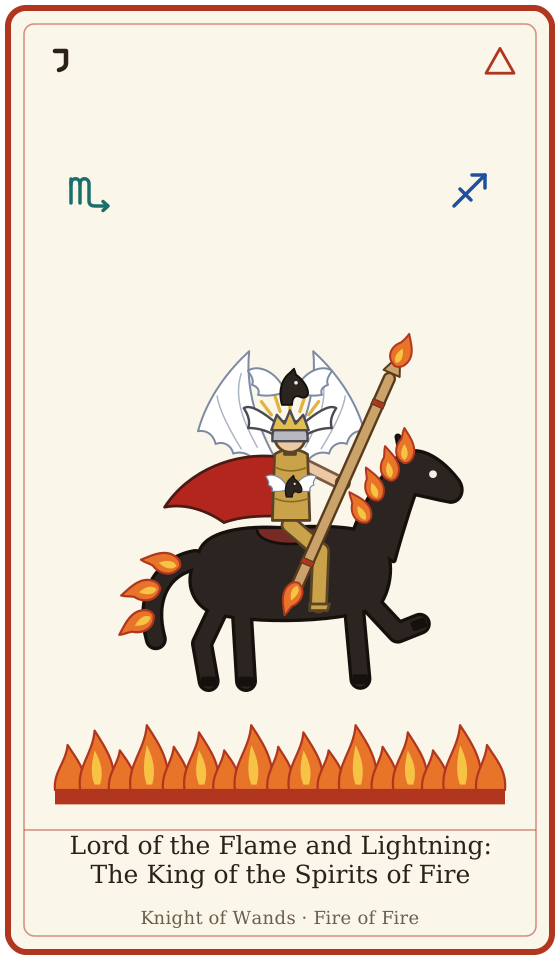 Book T deck, full imagery. PlayfulProcess: parts drawn for this deck (tarot/book-t/parts, tarot/book-t/glyphs), composed by script (scripts/build_book_t_full_imagery.py) from a spec per card that follows Book T (1912). CC-BY-SA-4.0.
 Book T deck, linocut. PlayfulProcess: a linocut printing of the full imagery, composed by script (scripts/build_book_t_linocut.py) from the same spec per card, which follows Book T (1912). CC-BY-SA-4.0.