c. 1442
Cary-Yale Visconti Tarot — The Lavish Outlier (c. 1442)
At a glance
An even earlier, extravagantly expanded Milanese game deck — possibly the oldest tarot fragment of all — notable for six ranks of court cards and for trumps depicting the three theological virtues (Faith, Hope, Charity) found almost nowhere else. A court game object, again from the Visconti world, again with no divinatory use.
Origin & dating
Held at Yale's Beinecke Library (the "Cary" of Cary-Yale; also called Visconti di Modrone). Giordano Berti dates it c.1442–1447 on numismatic grounds: the coin (denari) cards reproduce the gold florin struck by Filippo Maria Visconti in 1442 and withdrawn at his death in 1447. If correct, this is among the very earliest surviving tarot material.
Provenance & evidence
A fragmentary set (surviving cards number in the dozens). Its structural oddities are the key evidence: six courts (King, Queen, Knight, Jack plus a "Damsel" and a mounted "Lady"), and theological-virtue trumps that otherwise appear only in the much later Minchiate. This suggests the early trump set was not yet standardised — different courts experimented with how many triumphs to include.
Game or divination?
Game. The expansions are about enriching play and flattering a dynasty, not encoding secret doctrine. The virtue cards are conventional Christian moral allegory, the common visual currency of Renaissance courts.
The fear question
No fear — same logic as the Visconti-Sforza. Elite, heraldic, openly commissioned. If anything the Cary-Yale is more ostentatious (more gold, more courts), the opposite of something hidden.
Counter-voices
Because the Cary-Yale shares the theological virtues with Minchiate, some esoteric readers treat it as evidence of a lost "complete" sacred system later censored down to 22 trumps. The simpler, better-supported reading is the reverse: the early trump set was unfixed, and standardisation (not censorship) trimmed it over time.
Open questions / corrections owed
- Whether the virtues replaced standard trumps or were additional is unsettled.
- The c.1442 date leans on the florin argument; not all scholars accept it as decisive.
Sources & further reading
- "Cary-Yale Visconti Tarocchi Deck," learntarot.com; Beinecke Library highlights.
- "Tarocchi Visconti di Modrone (Cary-Yale)," Tarot Heritage (Berti dating).
- Dummett, The Game of Tarot (1980).
RESEARCH NOTE (2026-06-13). 67 cards survive of ~86 original. The six-rank courts (adding a Damsel and a Mounted Lady to King/Queen/Knight/Page) plus theological-virtue trumps make this the great outlier. NB a modelling issue: the extra court ranks currently collide on a four-archetype scheme (Damsel & Knave → page; Mounted Lady & Knight → knight) — needs distinct archetype ids. Bembo vs Zavattari attribution remains debated. See research/decks/cary-yale-visconti-tarot.md.
EDITORIAL CALL (2026-06-13): resolved the six-rank-court archetype collision — the Damsel now keys to `card:damsel-of-<suit>` and the Mounted Lady/Horsewoman to `card:horsewoman-of-<suit>` (was colliding with Page/Knight). 7 court cards re-keyed.
Where the pictures come from: who holds this deck's pictures, how sharp they are and what their rights allow: Sources: Cary-Yale Visconti.
The cards (67)
 The Emperor
 The Empress
 The Lovers
 The Chariot
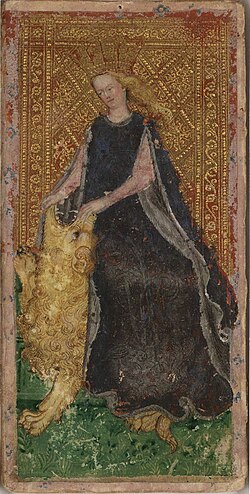 Strength
 Death
 Judgement
 The World
 Faith
 Hope
 Charity
 Ace of Coins
 Two of Coins
 Four of Coins
 Five of Coins
 Six of Coins
 Seven of Coins
 Eight of Coins
 Nine of Coins
 Ten of Coins
 Damsel of Coins
 Knight of Coins
 Horsewoman of Coins
 Queen of Coins
 King of Coins
 Ace of Cups
 Two of Cups
 Three of Cups
 Four of Cups
 Five of Cups
 Six of Cups
 Seven of Cups
 Eight of Cups
 Nine of Cups
 Ten of Cups
 Knave of Cups
 Damsel of Cups
 Knight of Cups
 King of Cups
 Ace of Swords
 Two of Swords
 Three of Swords
 Four of Swords
 Five of Swords
 Six of Swords
 Seven of Swords
 Eight of Swords
 Nine of Swords
 Ten of Swords
 Damsel of Swords
 Horsewoman of Swords
 Queen of Swords
 King of Swords
 Ace of Batons
 Two of Batons
 Three of Batons
 Four of Batons
 Five of Batons
 Six of Batons
 Seven of Batons
 Eight of Batons
 Nine of Batons
 Ten of Batons
 Knave of Batons
 Damsel of Batons
 Horsewoman of Batons
 Queen of Batons
Sources and credits
Beinecke Rare Book & Manuscript Library, Yale University (Cary Collection of Playing Cards)
- Bonifacio Bembo (workshop) (c. 1442): Painter of the Cary-Yale (Visconti di Modrone) Tarot, Milan
- Beinecke Rare Book & Manuscript Library, Yale (holding institution): Holds the 67 surviving Cary-Yale cards (Cary Collection of Playing Cards)
- Wikimedia Commons (public domain): Card images, Category:Cary-Yale Visconti Tarot
- PlayfulProcess (2026): Grammar architecture and summaries
Research dossier: research/decks/cary-yale-visconti-tarot.md. Data: tarot/cary-yale-visconti-tarot/grammar.json, CC-BY-SA-4.0. Images keep their own licences (hover a card for its credit).