The Contributor's path

Every deck here is a public-domain grammar anyone can correct, translate, or extend. Climb in by the gentlest route that suits you.

Read · the contributor's guide

Contribute to existing decks — or create your own

Fix a card, add a deck or a spread, write a course, or improve the site itself — by whatever route suits you, from a one-click edit in the app to full code. The deep guide walks every path.

Four ways to contribute — pick one

Creation-first · the gentlest route at the top

PathWhat you doStart
1In the app
recursive.eco · no code
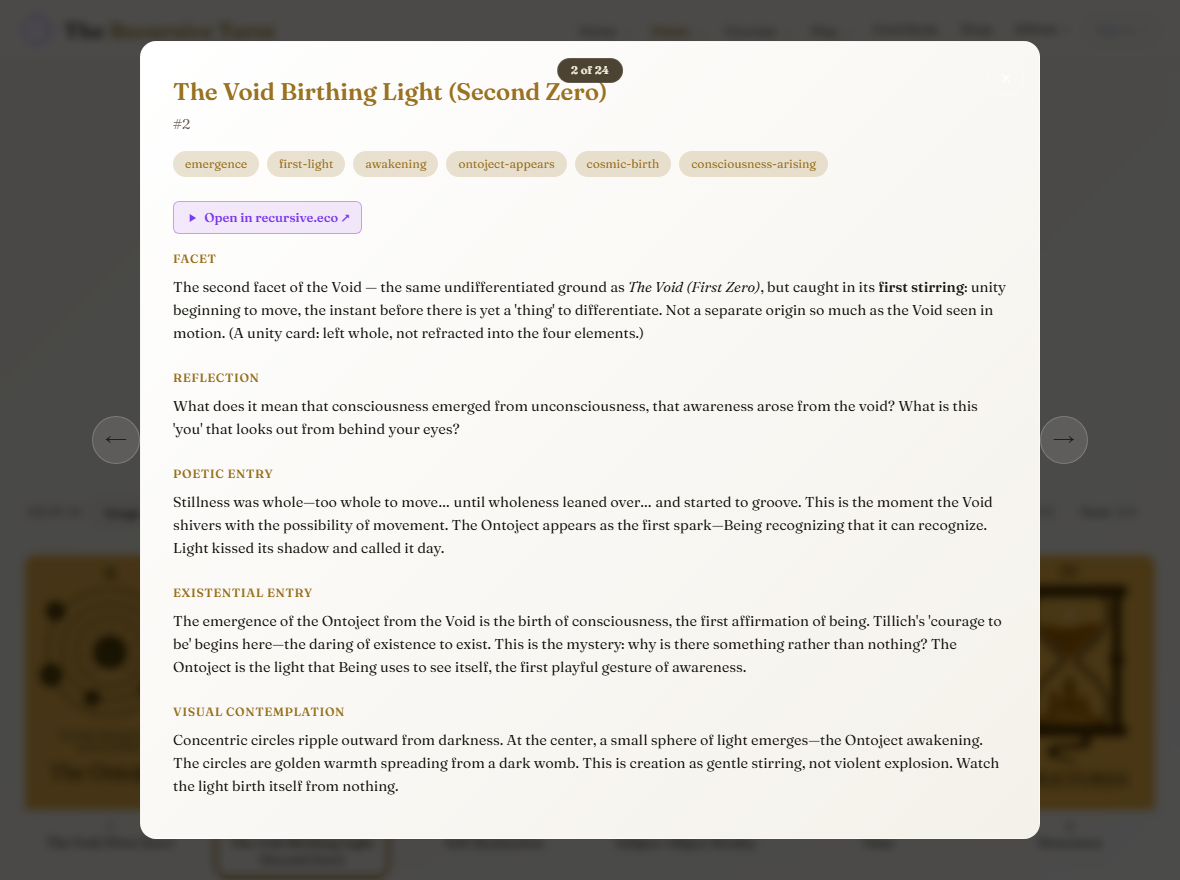
A card open in the browser with an 'Open in recursive.eco' action — propose a change without leaving the page.
Click through any card and propose a change — even without AI. The copy icon forks it to the Create page to edit inline; or just ask the Grammar Assistant to make the edit for you.
Edit a card now →
2On GitHub
web · a browser
Edit the deck's JSON in GitHub's web editor and open a pull request — no other tools needed.
Open the repo →
3In Claude.ai
chat · MCP recommended
Draft bigger edits in a chat, then open the PR. We recommend connecting the recursive.eco MCP so Claude can act on your library directly.
Read the steps →
4Fork & code
Claude Code Desktop + MCP
Clone the repo and edit like any coder — best with Claude Code Desktop + the MCP, working the whole library at once.
Read the steps →

From path 2 on, the same moves let you edit any part of this site — and they're the very skills you'd use to grow a library of your own. (We're building easier on-ramps for that; more soon.)

What you'd be tending

The open library, in its actual viewers


The Wish List

What's on the workbench right now, and what we'd like done before launch — a living list, and a menu of things a contributor could pick up.

On the workbench Before launch Done

On the workbench

What we're actively building

Flagship · a course that is a grammar

A history course, rendered straight from a grammar

"A History of Tarot" began as a single writing file. We taught the library to read it as a grammar — the same open format as every deck — so the course can be edited, forked, and previewed like anything else in the collection.

How it's made

  1. The course is written once as Markdown (history-of-tarot.mdx).
  2. A small converter turns it into a normal grammar — each section becomes a lesson; the card galleries become cross-grammar references to the real decks.
  3. grammar-course.html renders any grammar as a readable course, and a shared expander fills the live galleries — so the grammar version reads identically to the original.
The wish behind it

recursive.eco's Library Assistant can already open a course — but it can't see what's inside. A grammar it can read. Because the course is now a grammar, the assistant could answer questions about the actual content, not just point at the page.

On the workbench

Sync that never loses work

Making the recursive.eco ↔ GitHub channel-sync non-destructive: keep every repo-only field, hold a stable key order, so a sync proposal is small and reviewable instead of a 26,000-line wall.

On the workbench

Every grammar, every view

The Views menu should flip any grammar — deck, course, or guide — through Cards, Course, Explorer, Tree and Timeline without a broken view. Course view was the last gap; it now renders at parity.

See the guide as a course →
On the workbench

A new logo — emergence, not just iteration

The spiral captures iteration; we want a mark that also captures emergence and a more tree-like view — think a heart that falls, roots, and grows a whole forest. Drafts in progress.

See the logo studies →

Before launch

What we want done first

Before launch

Fix sync before resolving drifts

Don't merge the "resolve all drifts" pull requests until the roundtrip preserves repo-only fields — otherwise it strips licence blocks and enrichment from decks that look unchanged.

Before launch

Let the assistant read course grammars

Wire recursive.eco's Library Assistant to read a course's grammar content, so it can actually discuss the history, not just open the course page.

Before launch

Publish the course grammar

Offer "A History of Tarot" as a public, community-editable grammar on recursive.eco — the same path every deck takes.

Before launch

One last legibility pass

Walk every page and viewer in light only, confirm nothing is light-on-light, and finish the museum-restyle tokens on the remaining viewers.

Before launch

Provenance you can trust

Confirm every card image is public-domain with attribution, and every interpretive claim stays inside its source tradition — the floor the whole library stands on.

Done

Course-as-a-grammar renders at parity

The grammar version of the history course now shows the deck chapters, suit and trump galleries, maker bios and live maps — identical to the written course.

Open it →

This list lives in the open repo like everything else — see something missing? Open an issue or a pull request ↗.