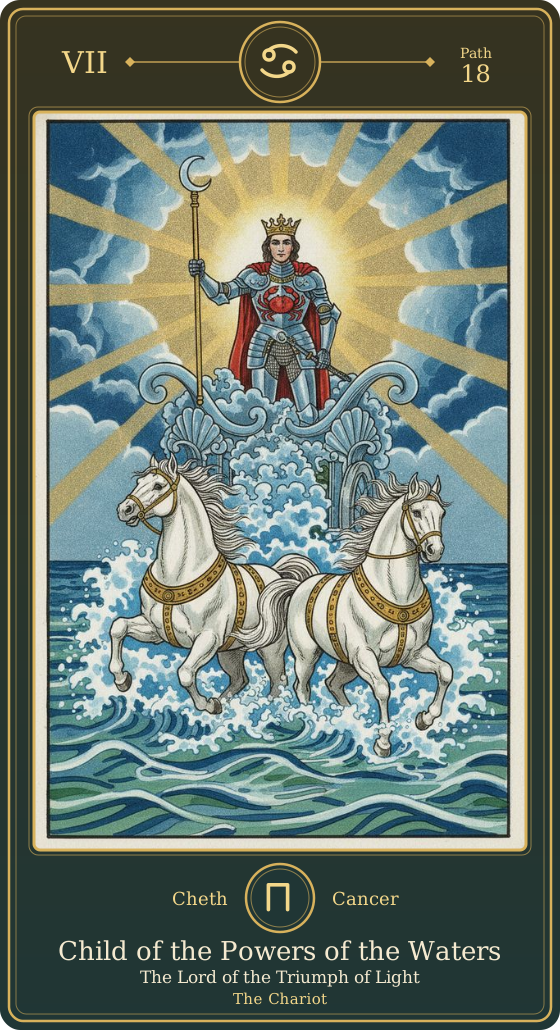
Book T no. 64 · Key 7 · Hebrew letter Cheth · Path 18
Child of the Powers of the Waters; the Lord of the Triumph of Light
The Chariot (Key 7) · The Child of the Powers of the Waters; the Lord of the Triumph of Light
Read to know yourself, not to surrender yourself: relate to the card; never obey it.
Book T (1912)
Triumph, victory, health (sometimes unstable).
Book T as printed in The Equinox I(8), 1912, public domain (notes in square brackets are Crowley's).
In Book T's table
No. 64 of Book T's 78 titles · The Chariot, Key 7 · letter ח Cheth · Cancer
Correspondences
Hebrew letter: ח (Cheth, 'fence') — path 18 on the Tree of Life.
On the Tree: path 18 joins Binah and Geburah · see it on the map
Attribution: Cancer.
(Classical Golden Dawn / Book T attribution. Modern decks add an outer planet — Uranus, Neptune, or Pluto — to the three elemental trumps.)
Waite, Pictorial Key (1911)
A. E. Waite, a member of the Golden Dawn, in The Pictorial Key to the Tarot (London, 1911) · public domain · he describes the Rider-Waite-Smith picture of this card, not Book T's
An erect and princely figure carrying a drawn sword and corresponding, broadly speaking, to the traditional description which I have given in the first part. On the shoulders of the victorious hero are supposed to be the Urim and Thummim. He has led captivity captive; he is conquest on all planes— in the mind, in science, in progress, in certain trials of initiation. He has thus replied to the
sphinx, and it is on this account that I have accepted the variation of Eliphas Levi; two sphinxes thus draw his chariot. He is above all things triumph in the mind.
It is to be understood for this reason (a) that the question of the sphinx is concerned with a Mystery of Nature and not of the world of Grace, to which the charioteer could offer no answer; (b) that the planes of his conquest are manifest or external and not within himself; (c) that the liberation which he effects may leave himself in the bondage of the logical understanding; (d) that the tests of initiation through which he has passed in triumph are to be understood physically or rationally; and (e) that if he came to the pillars of that Temple between which the High Priestess is seated, he could not open the scroll called Tora, nor if she questioned him could he answer. He is not hereditary royalty and he is not priesthood.
Case, Introduction to the Tarot (1920)
Paul Foster Case, in An Introduction to the Study of the Tarot (New York, 1920), Chapter III, on the letter Cheth · public domain in the US · the whole booklet
Field: location; that which requires cultivation.
East-below: combines East (Daleth) and Below (Gimel); opposite of West-below (Ayin); complement of East-above (Zain).
Cancer: diurnal and nocturnal house of the moon (Gimel).
Speech: mastery of language is mastery of thought; the practical occultist devotes much labor to the field of speech.
Intelligence of Influence: joins Binah to Geburah.
Picture sets
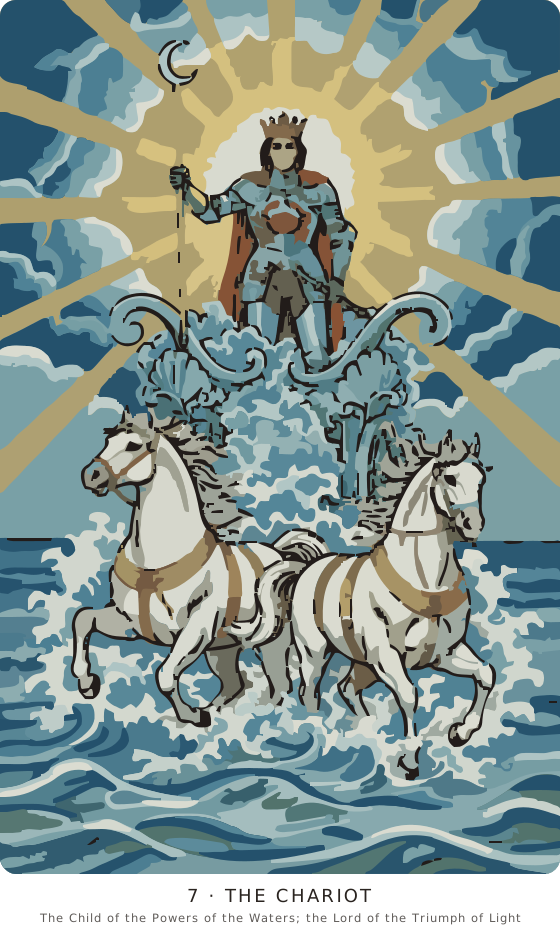 Book T deck, SVG. PlayfulProcess (line art traced from the AI painting). CC-BY-SA-4.0.
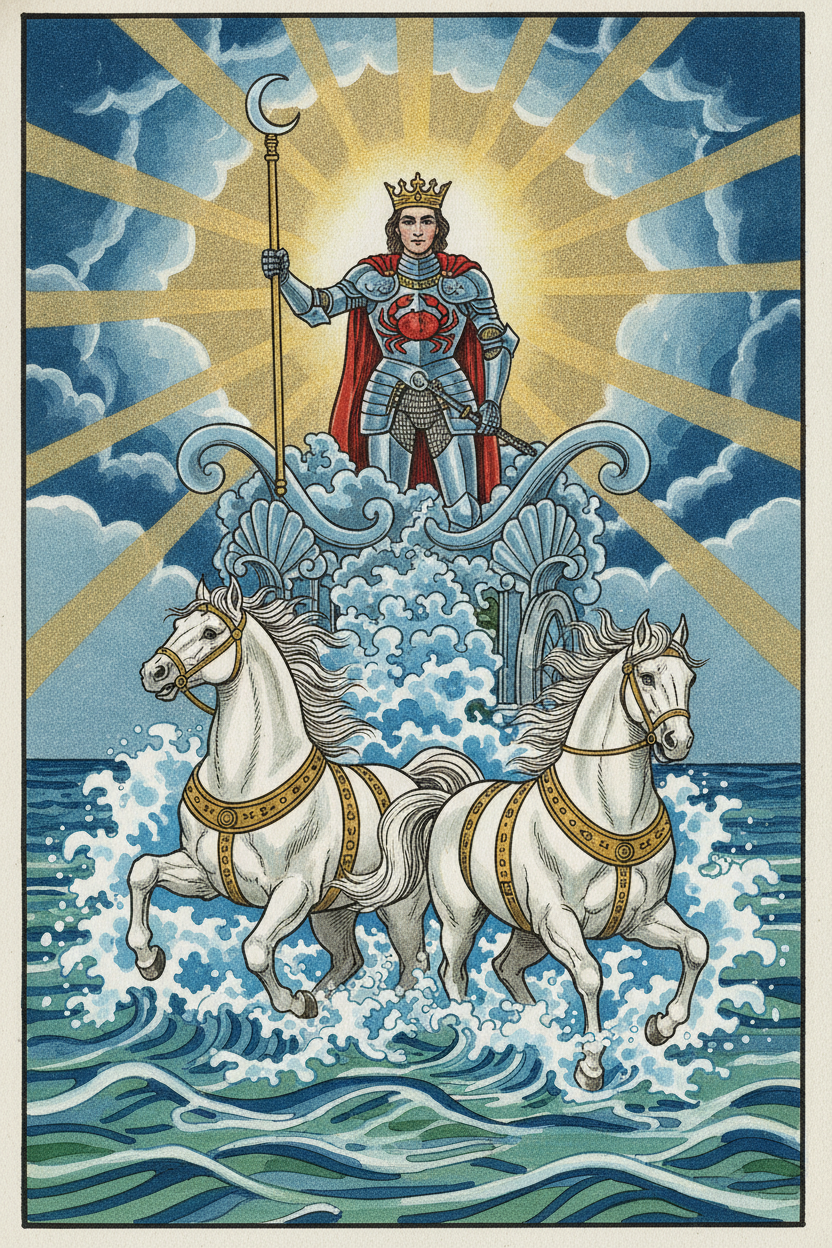 Book T deck, painting. AI painting (gemini-2.5-flash-image) from Book T's words, prompt by PlayfulProcess. CC-BY-SA-4.0.
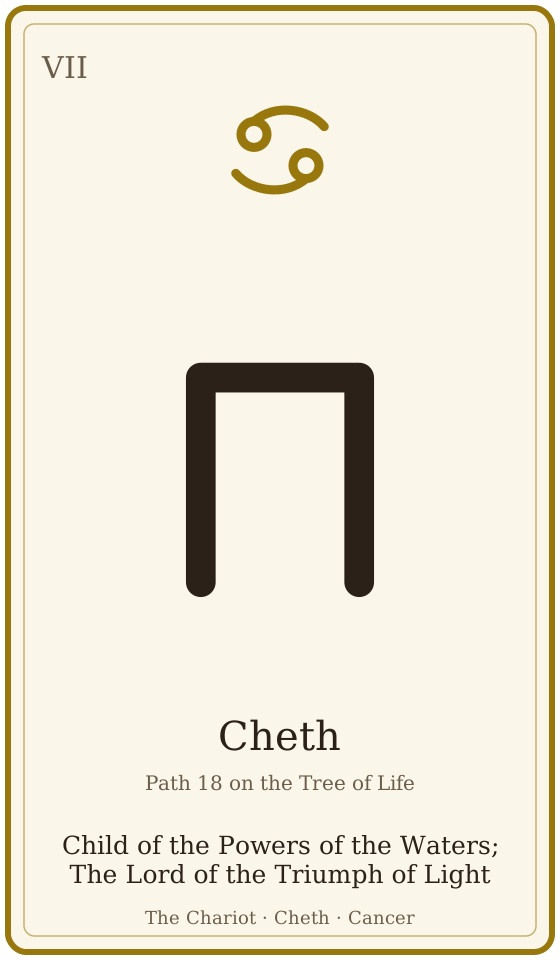 Book T deck, iconography. PlayfulProcess: glyphs drawn for this deck, composed by script (scripts/build_book_t_iconography.py) from the card's own metadata, placed as Book T (1912) places them. CC-BY-SA-4.0.
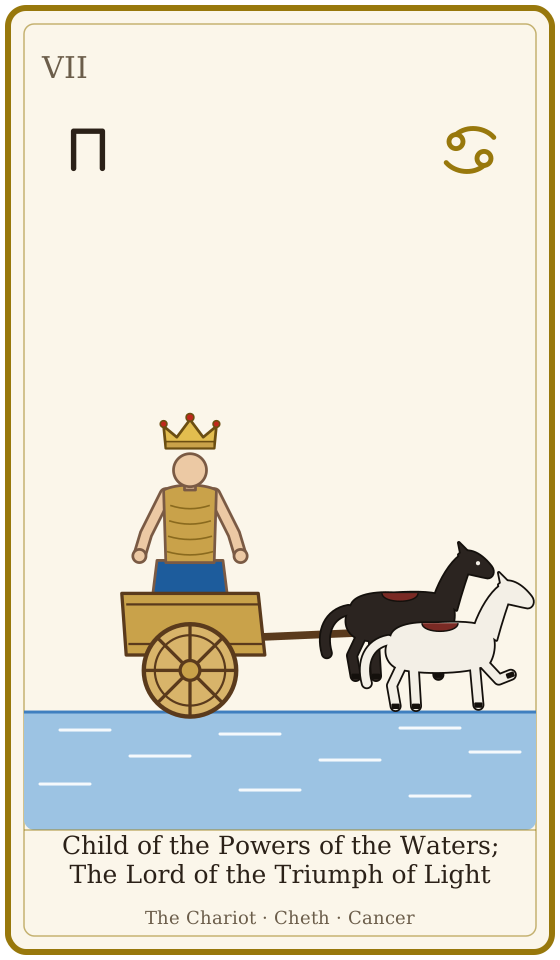 Book T deck, full imagery. PlayfulProcess: parts drawn for this deck (tarot/book-t/parts, tarot/book-t/glyphs), composed by script (scripts/build_book_t_full_imagery.py) from a spec per card that follows Book T (1912). CC-BY-SA-4.0.
 Book T deck, linocut. PlayfulProcess: a linocut printing of the full imagery, composed by script (scripts/build_book_t_linocut.py) from the same spec per card, which follows Book T (1912). CC-BY-SA-4.0.