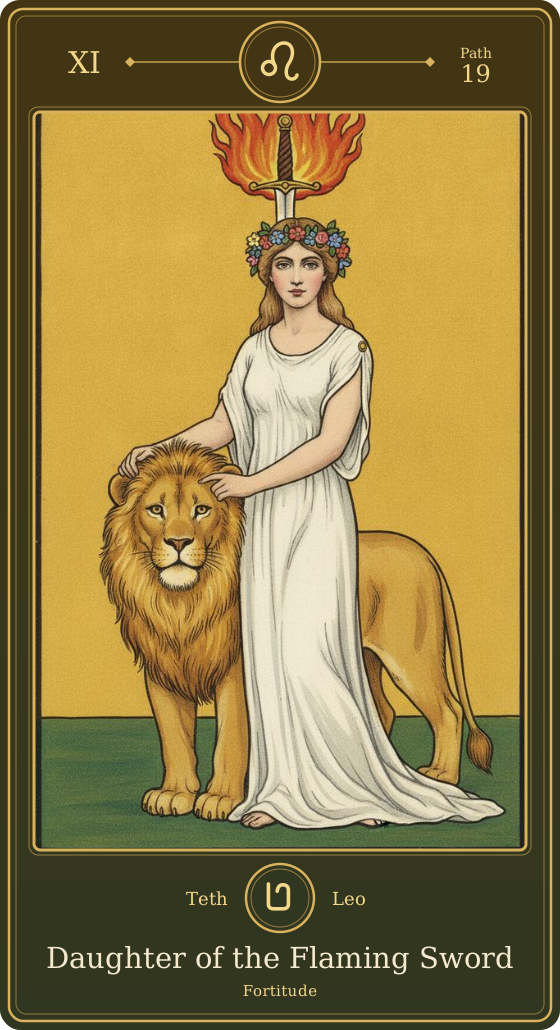
Book T no. 65 · Key 11 · Hebrew letter Teth · Path 19
Daughter of the Flaming Sword
Fortitude (Key 11) · The Daughter of the Flaming Sword
Read to know yourself, not to surrender yourself: relate to the card; never obey it.
Book T (1912)
Courage, strength, fortitude, power passing on to action. Obstinacy.
Book T as printed in The Equinox I(8), 1912, public domain (notes in square brackets are Crowley's).
In Book T's table
No. 65 of Book T's 78 titles · Fortitude, Key 11 · letter ט Teth · Leo
Book T numbers Justice 8 and Fortitude 11, and seats Fortitude on Leo, the letter Teth, in the eighth place among the Keys.
Correspondences
Hebrew letter: ט (Teth, 'serpent') — path 19 on the Tree of Life.
On the Tree: path 19 joins Chesed and Geburah · see it on the map
Attribution: Leo.
(Classical Golden Dawn / Book T attribution. Modern decks add an outer planet — Uranus, Neptune, or Pluto — to the three elemental trumps.)
Waite, Pictorial Key (1911)
A. E. Waite, a member of the Golden Dawn, in The Pictorial Key to the Tarot (London, 1911) · public domain · he describes the Rider-Waite-Smith picture of this card, not Book T's
A woman, over whose head there broods the same symbol of life which we have seen in the card of the Magician, is closing the jaws of a lion. The only point in which this design differs from the conventional presentations is that her beneficent fortitude has already subdued the lion, which is being led by a chain of flowers. For reasons which satisfy myself, this card has been interchanged with that of Justice, which is usually numbered eight. As the variation carries nothing with it which will signify to the reader, there is no cause for explanation. Fortitude, in one of its most exalted aspects, is connected with the Divine Mystery of Union; the virtue, of course, operates in all planes, and hence draws on all in its symbolism. It connects also with innocentia inviolata, and with the strength which resides in contemplation.
These higher meanings are, however, matters of inference, and I do not suggest that they are transparent on the surface of the card. They are intimated in a concealed manner by the chain of flowers, which signifies, among many other things, the sweet yoke and the light burden of Divine Law, when it has been taken into the heart of hearts. The card has nothing to do with self-confidence in the ordinary sense, though this has been suggested— but it concerns the confidence of those whose strength is God, who have found their refuge in Him. There is one aspect in which the lion signifies the passions, and she who is called Strength is the higher nature in its liberation. It has walked upon the asp and the basilisk and has trodden down the lion and the dragon.
Case, Introduction to the Tarot (1920)
Paul Foster Case, in An Introduction to the Study of the Tarot (New York, 1920), Chapter III, on the letter Teth · public domain in the US · the whole booklet
Serpent: wisdom, subtlety, secrecy; regeneration; Eliphas Levi's “Astral Light.” Taste: refinement; experience; enduring. patience, fortitude.
North-above: combines North (Peh) and Above (Beth) ; opposite of South-above (Tzaddi) ; complement of North-below (Yod).
Leo: diurnal and nocturnal house of the sun (Resh).
Intelligence of the Secret: joins Chesed to Geburah.
Picture sets
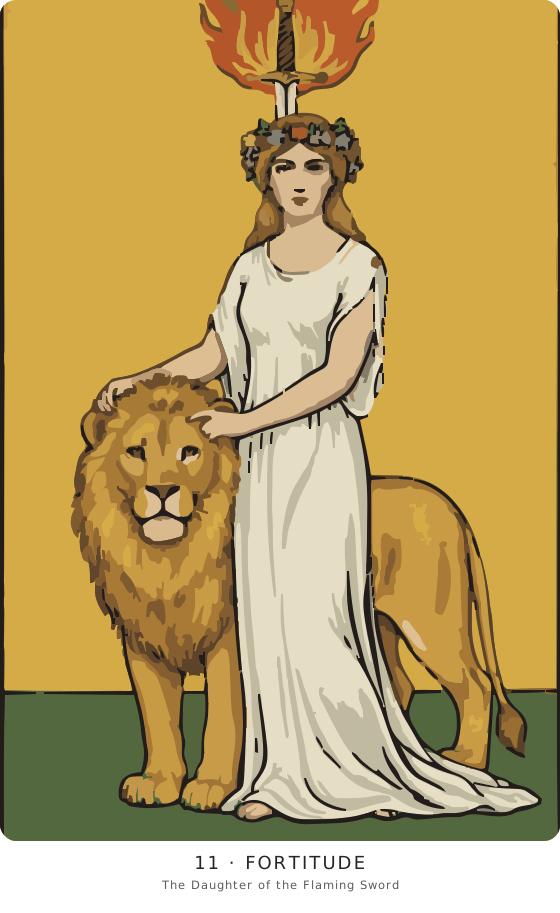 Book T deck, SVG. PlayfulProcess (line art traced from the AI painting). CC-BY-SA-4.0.
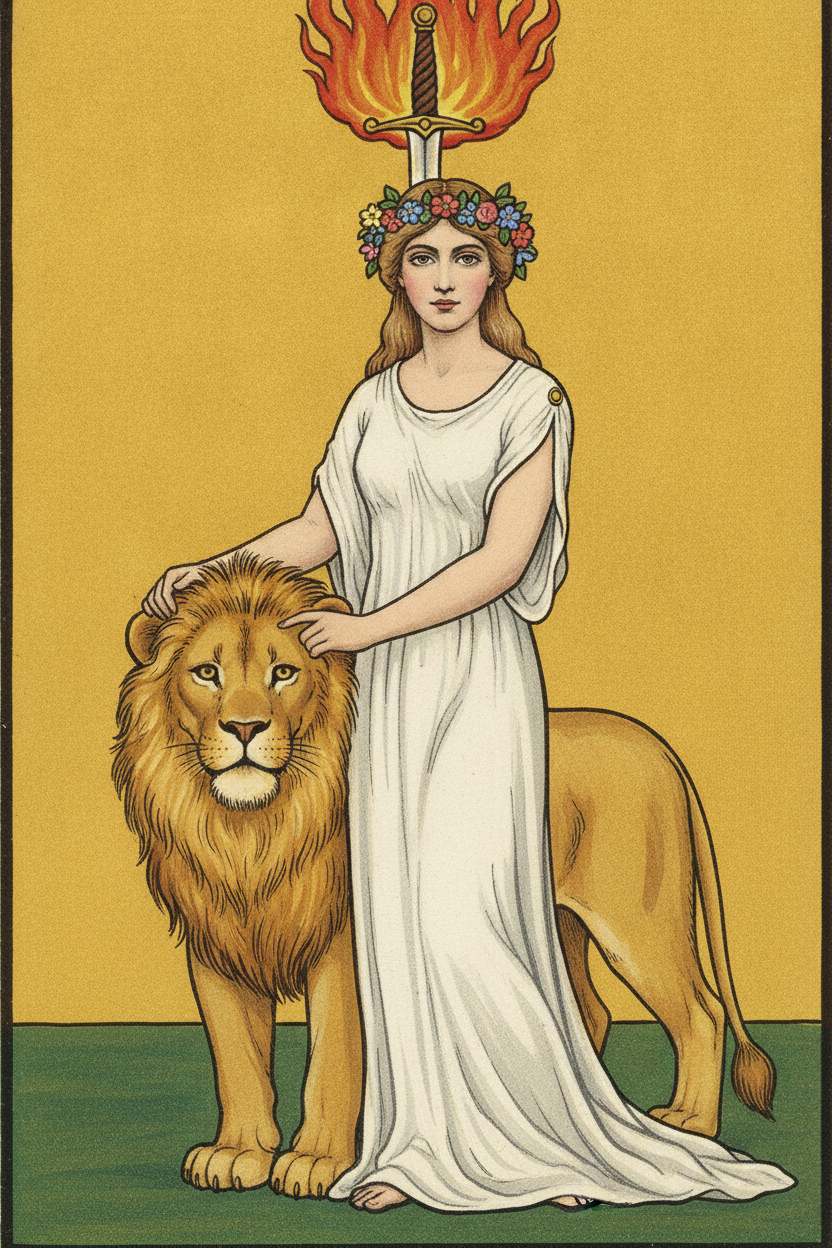 Book T deck, painting. AI painting (gemini-2.5-flash-image) from Book T's words, prompt by PlayfulProcess. CC-BY-SA-4.0.
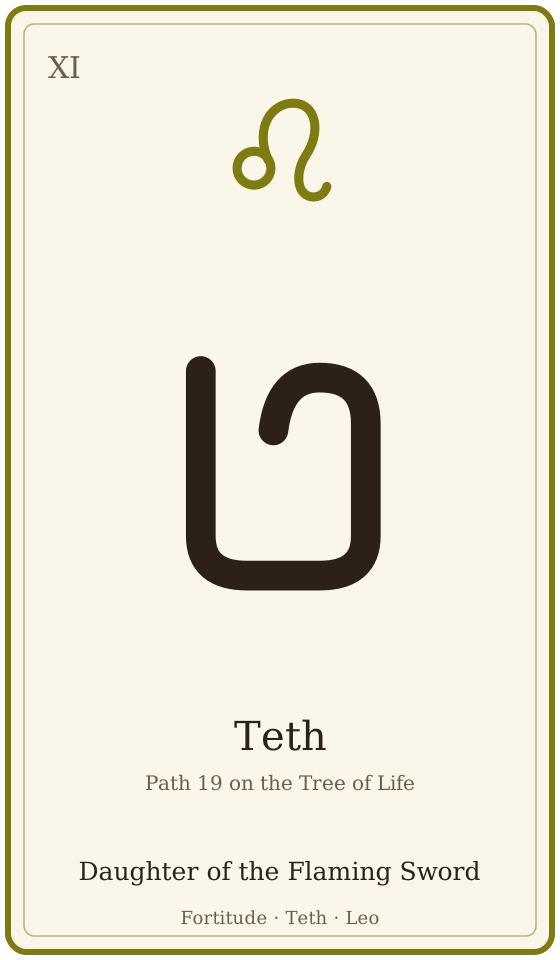 Book T deck, iconography. PlayfulProcess: glyphs drawn for this deck, composed by script (scripts/build_book_t_iconography.py) from the card's own metadata, placed as Book T (1912) places them. CC-BY-SA-4.0.
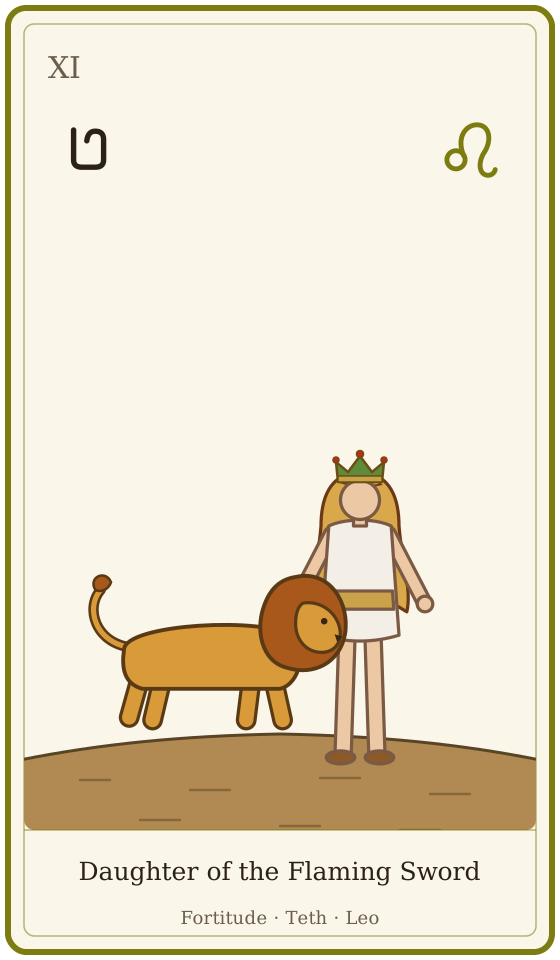 Book T deck, full imagery. PlayfulProcess: parts drawn for this deck (tarot/book-t/parts, tarot/book-t/glyphs), composed by script (scripts/build_book_t_full_imagery.py) from a spec per card that follows Book T (1912). CC-BY-SA-4.0.
 Book T deck, linocut. PlayfulProcess: a linocut printing of the full imagery, composed by script (scripts/build_book_t_linocut.py) from the same spec per card, which follows Book T (1912). CC-BY-SA-4.0.