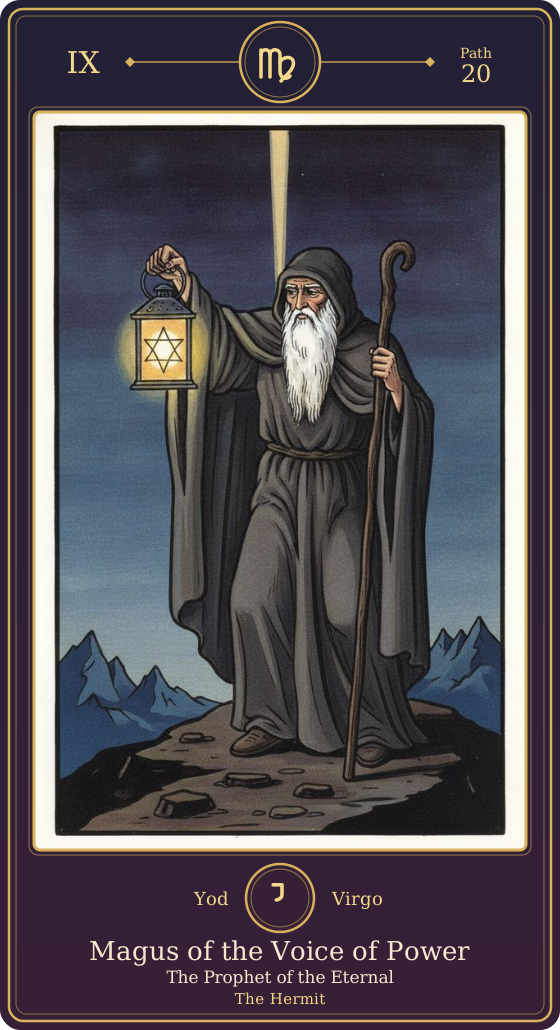
Book T no. 66 · Key 9 · Hebrew letter Yod · Path 20
Magus of the Voice of Power, the Prophet of the Eternal
The Hermit (Key 9) · The Magus of the Voice of Power, the Prophet of the Eternal
Read to know yourself, not to surrender yourself: relate to the card; never obey it.
Book T (1912)
Wisdom from on high. Active divine inspiration. Sometimes "unexpected current."
Book T as printed in The Equinox I(8), 1912, public domain (notes in square brackets are Crowley's).
In Book T's table
No. 66 of Book T's 78 titles · The Hermit, Key 9 · letter י Yod · Virgo
Correspondences
Hebrew letter: י (Yod, 'hand') — path 20 on the Tree of Life.
On the Tree: path 20 joins Chesed and Tiphareth · see it on the map
Attribution: Virgo.
(Classical Golden Dawn / Book T attribution. Modern decks add an outer planet — Uranus, Neptune, or Pluto — to the three elemental trumps.)
Waite, Pictorial Key (1911)
A. E. Waite, a member of the Golden Dawn, in The Pictorial Key to the Tarot (London, 1911) · public domain · he describes the Rider-Waite-Smith picture of this card, not Book T's
The variation from the conventional models in this card is only that the lamp is not enveloped partially in the mantle of its bearer, who blends the idea of the Ancient of Days with the Light of the World. It is a star which shines in the lantern. I have said that this is a card of attainment, and to extend this conception the figure is seen holding up his beacon on an eminence. Therefore the Hermit is not, as Court de Gebelin explained, a wise man in search of truth and justice; nor is he, as a later explanation proposes, an especial example of experience. His beacon intimates that "where I am, you also may be."
It is further a card which is understood quite incorrectly when it is connected with the idea of occult isolation, as the protection of personal magnetism against admixture. This is one of the frivolous renderings which we owe to Eliphas Levi. It has been adopted by the French Order of Martinism and some of us have heard a great deal of the Silent and Unknown Philosophy enveloped by his mantle from the knowledge of the profane. In true Martinism, the significance of the term Philosophe inconnu was of another order. It did not refer to the intended concealment of the Instituted Mysteries, much less of their substitutes, but— like the card itself— to the truth that the Divine Mysteries secure their own protection from those who are unprepared.
Case, Introduction to the Tarot (1920)
Paul Foster Case, in An Introduction to the Study of the Tarot (New York, 1920), Chapter III, on the letter Yod · public domain in the US · the whole booklet
Hand: dexterity, skill; power, might, supremacy; symbol of the Supreme Spirit.
North-below: combines North (Peh) and Below (Gimel); opposite of South-below, (Qoph) ; complement of North-above (Teth).
Virgo: nocturnal house of Mercury (Beth) ; complement of Gemini (Zain), the diurnal house. Coition: the union of the male and female, the fixed and the volatile.
Intelligence of Will: joins Chesed to Tiphareth.
Picture sets
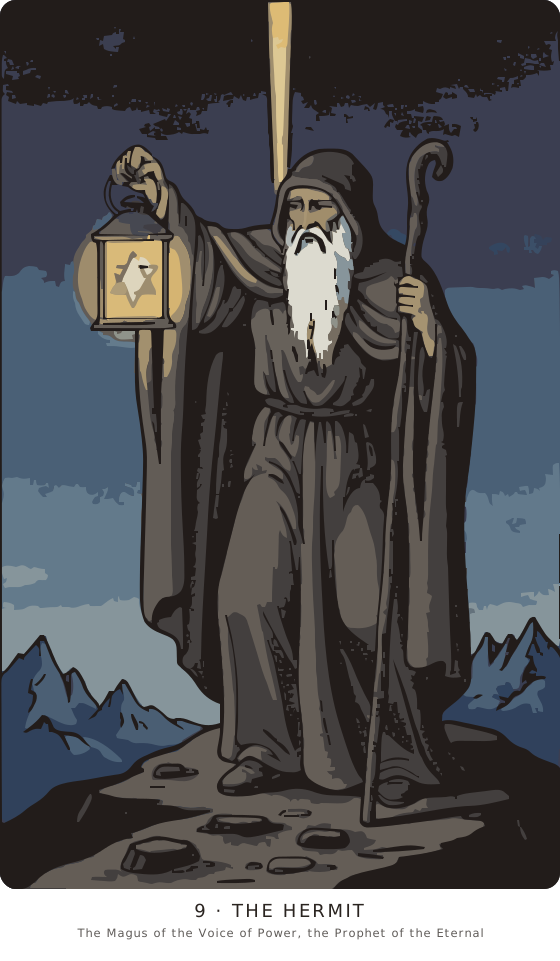 Book T deck, SVG. PlayfulProcess (line art traced from the AI painting). CC-BY-SA-4.0.
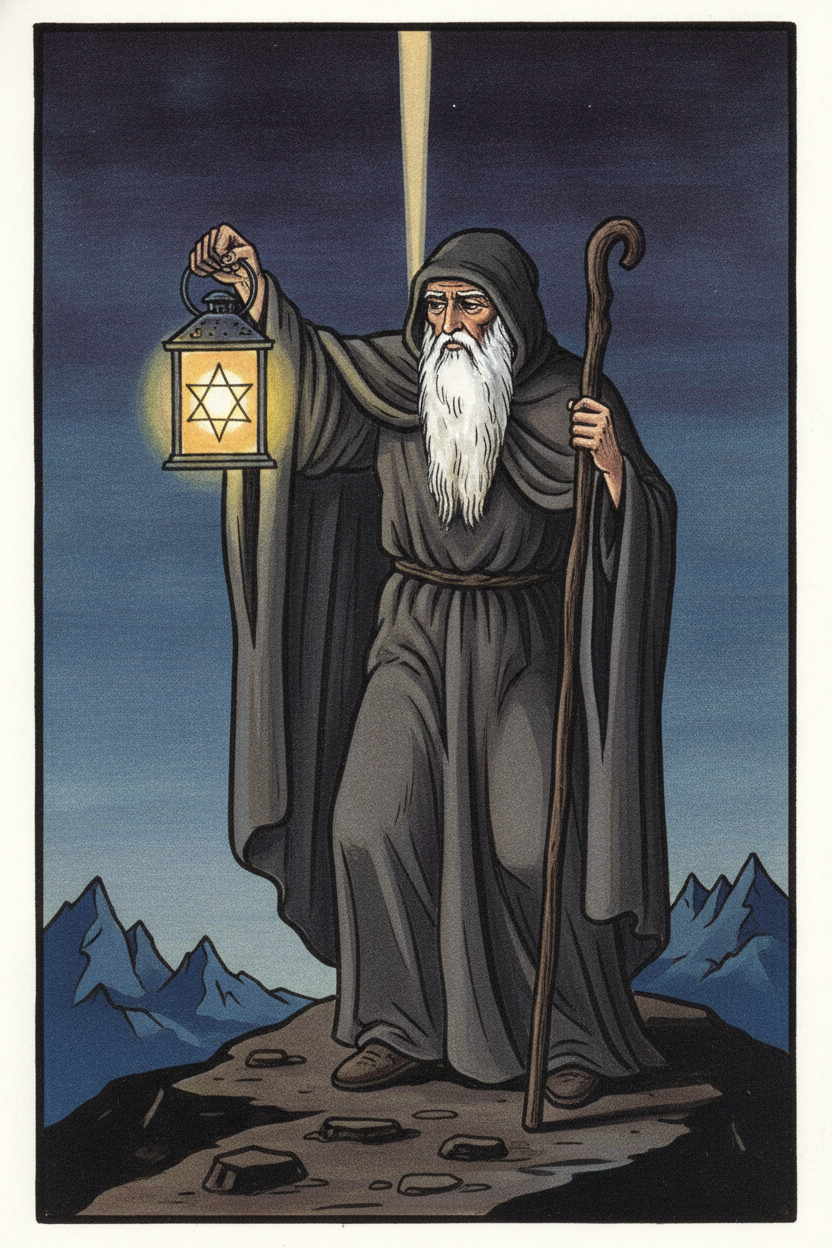 Book T deck, painting. AI painting (gemini-2.5-flash-image) from Book T's words, prompt by PlayfulProcess. CC-BY-SA-4.0.
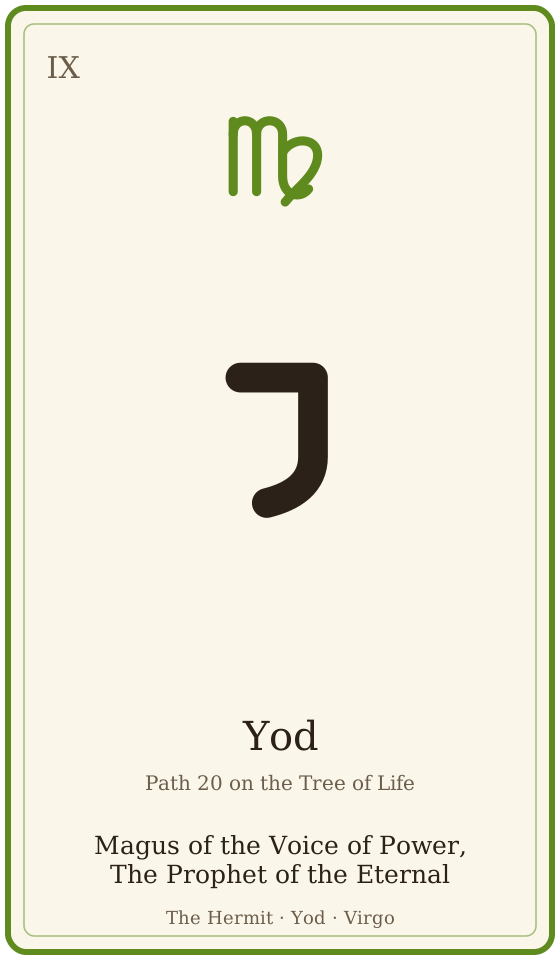 Book T deck, iconography. PlayfulProcess: glyphs drawn for this deck, composed by script (scripts/build_book_t_iconography.py) from the card's own metadata, placed as Book T (1912) places them. CC-BY-SA-4.0.
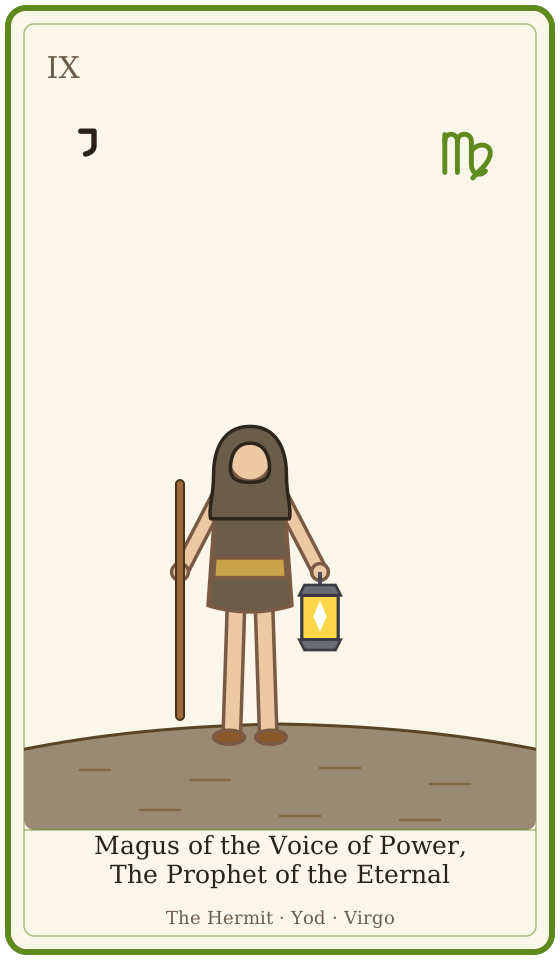 Book T deck, full imagery. PlayfulProcess: parts drawn for this deck (tarot/book-t/parts, tarot/book-t/glyphs), composed by script (scripts/build_book_t_full_imagery.py) from a spec per card that follows Book T (1912). CC-BY-SA-4.0.
 Book T deck, linocut. PlayfulProcess: a linocut printing of the full imagery, composed by script (scripts/build_book_t_linocut.py) from the same spec per card, which follows Book T (1912). CC-BY-SA-4.0.