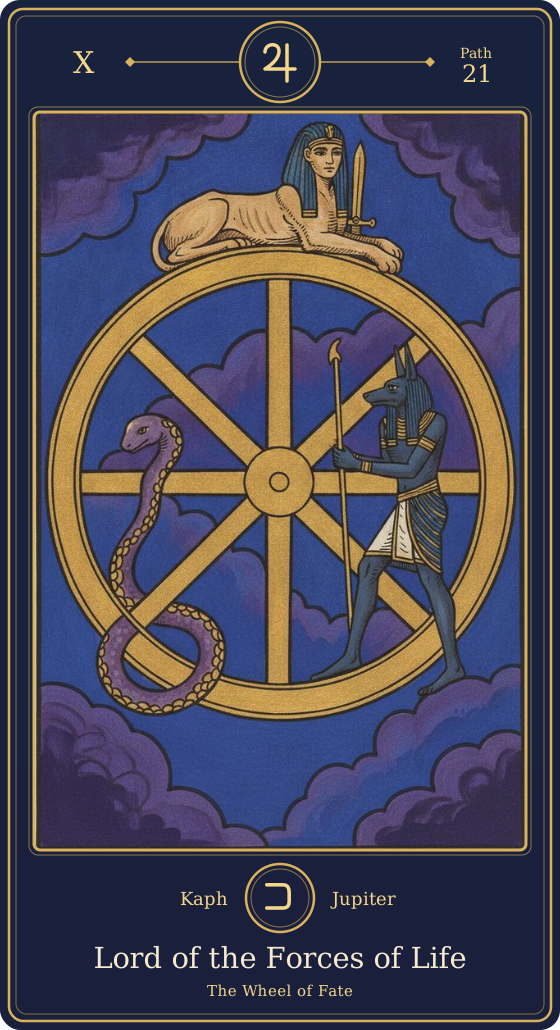
Book T no. 67 · Key 10 · Hebrew letter Kaph · Path 21
Lord of the Forces of Life
The Wheel of Fate (Key 10) · The Lord of the Forces of Life
Read to know yourself, not to surrender yourself: relate to the card; never obey it.
Book T (1912)
Good fortune, happiness (within bounds). Intoxication of success.
Book T as printed in The Equinox I(8), 1912, public domain (notes in square brackets are Crowley's).
In Book T's table
No. 67 of Book T's 78 titles · The Wheel of Fate, Key 10 · letter כ Kaph · Jupiter
Correspondences
Hebrew letter: כ (Kaph, 'palm') — path 21 on the Tree of Life.
On the Tree: path 21 joins Chesed and Netzach · see it on the map
Attribution: Jupiter.
(Classical Golden Dawn / Book T attribution. Modern decks add an outer planet — Uranus, Neptune, or Pluto — to the three elemental trumps.)
Waite, Pictorial Key (1911)
A. E. Waite, a member of the Golden Dawn, in The Pictorial Key to the Tarot (London, 1911) · public domain · he describes the Rider-Waite-Smith picture of this card, not Book T's
In this symbol I have again followed the reconstruction of Eliphas Levi, who has furnished several variants. It is legitimate— as I have intimated— to use Egyptian symbolism when this serves our purpose, provided that no theory of origin is implied therein. I have, however, presented Typhon in his serpent form. The symbolism is, of course, not exclusively Egyptian, as the four Living Creatures of Ezekiel occupy the angles of the card, and the wheel itself follows other indications of Levi in respect of Ezekiel's vision, as illustrative of the particular Tarot Key. With the French occultist, and in the design itself, the symbolic picture stands for the perpetual motion of a fluidic universe and for the flux of human life. The Sphinx is the equilibrium therein. The transliteration of Taro as Rota is inscribed on the wheel, counterchanged with the letters of the Divine Name— to shew that Providence is implied through all. But this is the Divine intention within, and the similar intention without is exemplified by the four Living Creatures. Sometimes the sphinx is represented couchant on a pedestal above, which defrauds the symbolism by stultifying the essential idea of stability amidst movement.
Behind the general notion expressed in the symbol there lies the denial of chance and the fatality which is implied therein. It may be added that, from the days of Levi onward, the occult explanations of this card are— even for occultism itself— of a singularly fatuous kind. It has been said to mean principle, fecundity, virile honour, ruling authority, etc. The findings of common fortune-telling are better than this on their own plane.
Case, Introduction to the Tarot (1920)
Paul Foster Case, in An Introduction to the Study of the Tarot (New York, 1920), Chapter III, on the letter Kaph · public domain in the US · the whole booklet
Grasping Hand: control; authority; comprehension; property.
West: opposite of East (Daleth).
Jupiter: rules Sagittarius (Samekh) by day, and Pisces (Qoph) by night.
Wealth and Poverty: the extremes of “property”; the external signs of one's grasp of circumstances. Intelligence of Conciliation; accommodation of differences; adjustment, establishment of orders; joins Chesed to Netzach.
Picture sets
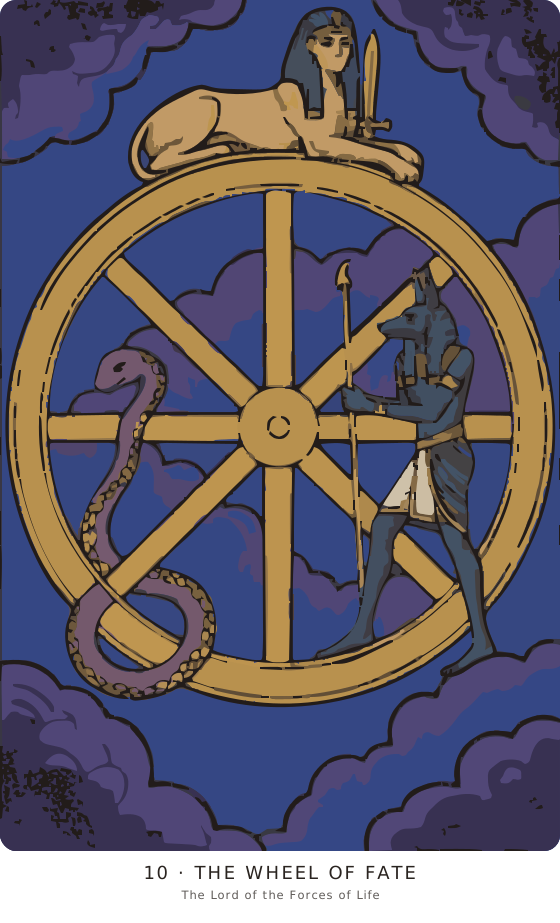 Book T deck, SVG. PlayfulProcess (line art traced from the AI painting). CC-BY-SA-4.0.
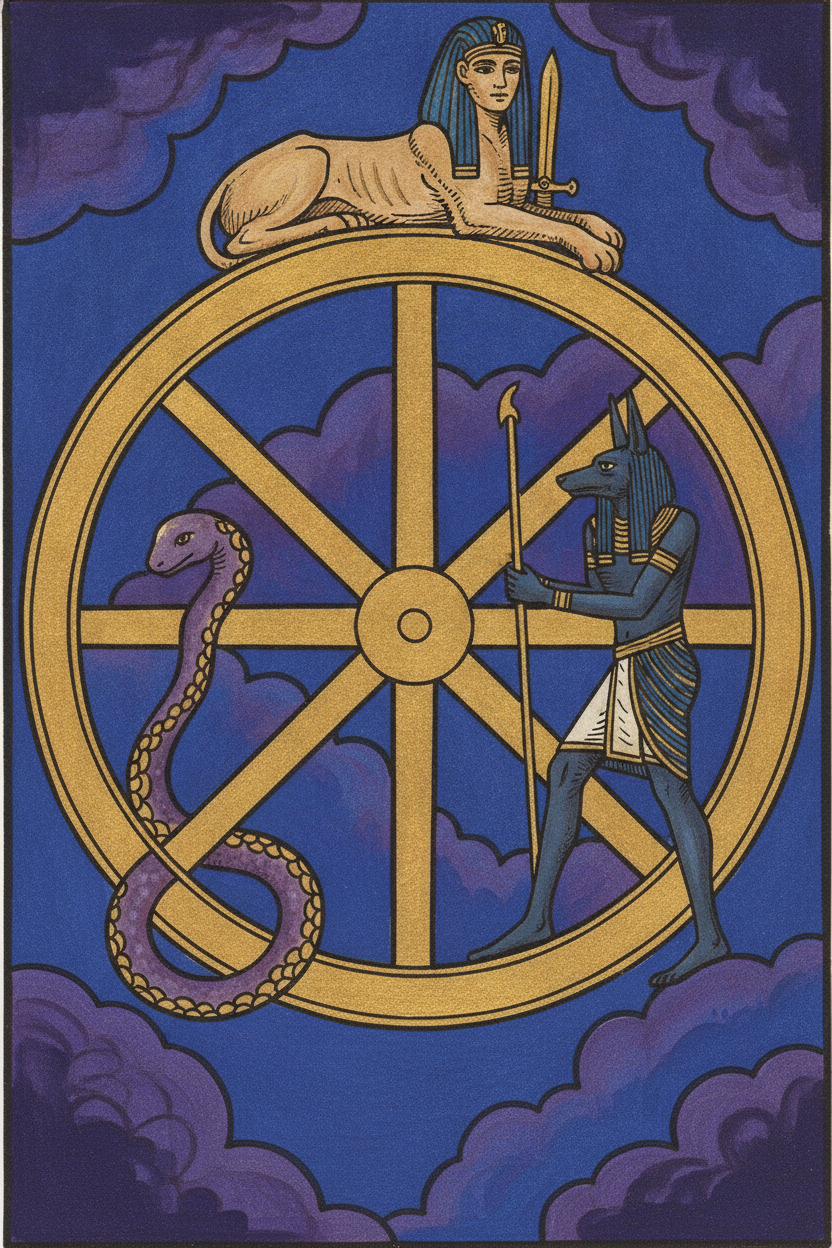 Book T deck, painting. AI painting (gemini-2.5-flash-image) from Book T's words, prompt by PlayfulProcess. CC-BY-SA-4.0.
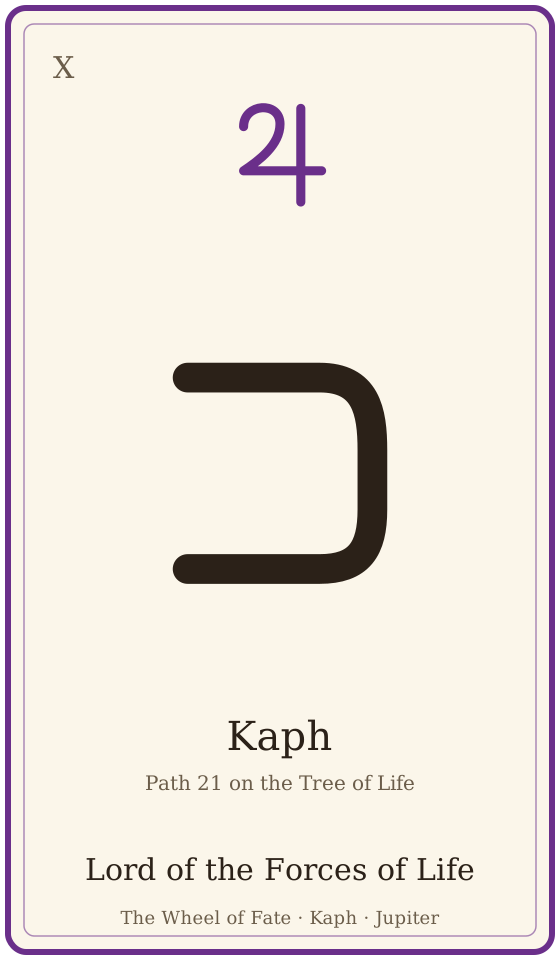 Book T deck, iconography. PlayfulProcess: glyphs drawn for this deck, composed by script (scripts/build_book_t_iconography.py) from the card's own metadata, placed as Book T (1912) places them. CC-BY-SA-4.0.
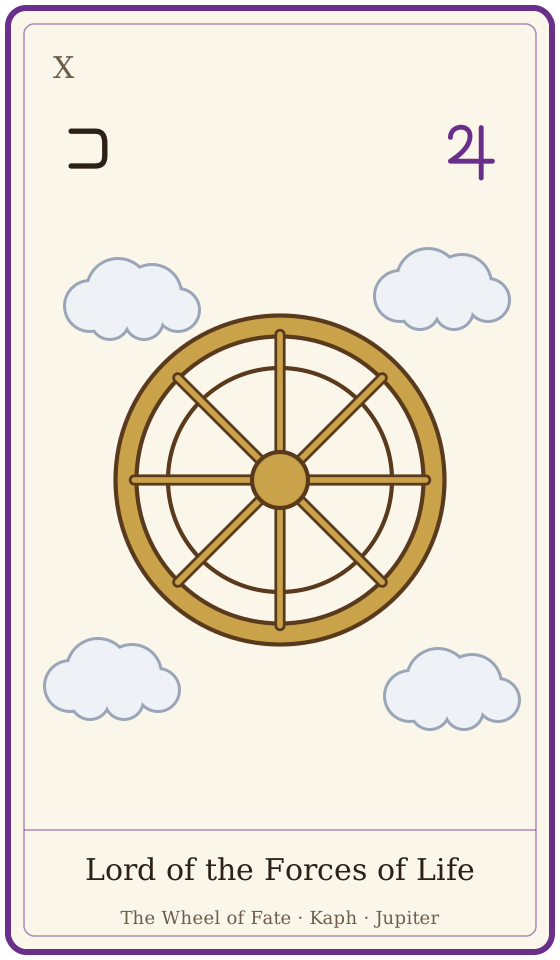 Book T deck, full imagery. PlayfulProcess: parts drawn for this deck (tarot/book-t/parts, tarot/book-t/glyphs), composed by script (scripts/build_book_t_full_imagery.py) from a spec per card that follows Book T (1912). CC-BY-SA-4.0.
 Book T deck, linocut. PlayfulProcess: a linocut printing of the full imagery, composed by script (scripts/build_book_t_linocut.py) from the same spec per card, which follows Book T (1912). CC-BY-SA-4.0.