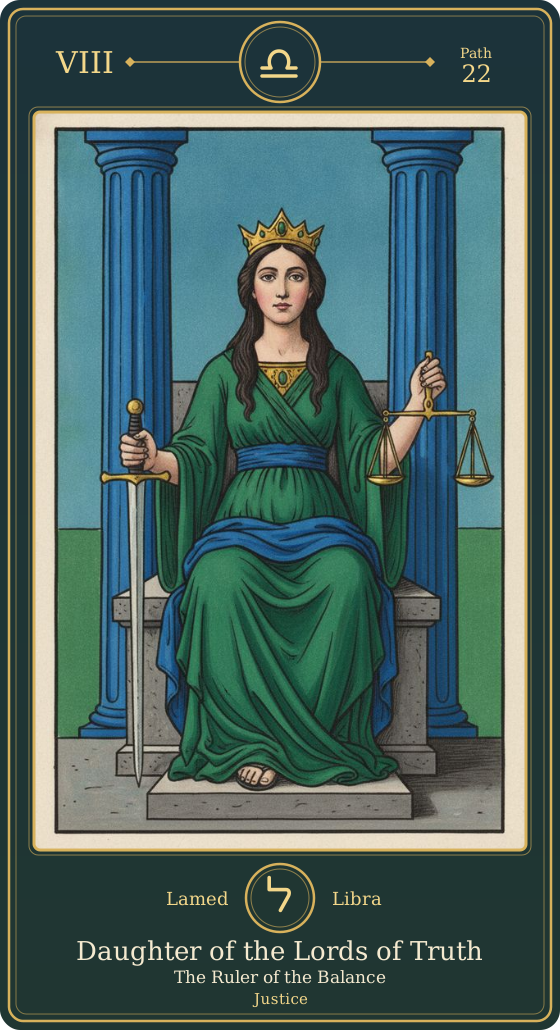
Book T no. 68 · Key 8 · Hebrew letter Lamed · Path 22
Daughter of the Lords of Truth: the Ruler of the Balance
Justice (Key 8) · The Daughter of the Lords of Truth: the Ruler of the Balance
Read to know yourself, not to surrender yourself: relate to the card; never obey it.
Book T (1912)
Eternal justice. Strength and force, but arrested as in act of judgment. May mean law, trial, etc.
Book T as printed in The Equinox I(8), 1912, public domain (notes in square brackets are Crowley's).
In Book T's table
No. 68 of Book T's 78 titles · Justice, Key 8 · letter ל Lamed · Libra
Book T numbers Justice 8 and Fortitude 11, and seats Fortitude on Leo, the letter Teth, in the eighth place among the Keys.
Correspondences
Hebrew letter: ל (Lamed, 'ox-goad') — path 22 on the Tree of Life.
On the Tree: path 22 joins Geburah and Tiphareth · see it on the map
Attribution: Libra.
(Classical Golden Dawn / Book T attribution. Modern decks add an outer planet — Uranus, Neptune, or Pluto — to the three elemental trumps.)
Waite, Pictorial Key (1911)
A. E. Waite, a member of the Golden Dawn, in The Pictorial Key to the Tarot (London, 1911) · public domain · he describes the Rider-Waite-Smith picture of this card, not Book T's
As this card follows the traditional symbolism and carries above all its obvious meanings, there is little to say regarding it outside the few considerations collected in the first part, to which the reader is referred.
It will be seen, however, that the figure is seated between pillars, like the High Priestess, and on this account it seems desirable to indicate that the moral principle which deals unto every man according to his works— while, of course, it is in strict analogy with higher things—differs in its essence from the spiritual justice which is involved in the idea of election. The latter belongs to a mysterious order of Providence, in virtue of which it is possible for certain men to conceive the idea of dedication to the highest things. The operation of this is like the breathing of the Spirit where it wills, and we have no canon of criticism or ground of explanation concerning it. It is analogous to the possession of the fairy gifts and the high gifts and the gracious gifts of the poet: we have them or have not, and their presence is as much a mystery as their absence. The law of Justice is not however involved by either alternative. In conclusion, the pillars of Justice open into one world and the pillars of the High Priestess into another.
Case, Introduction to the Tarot (1920)
Paul Foster Case, in An Introduction to the Study of the Tarot (New York, 1920), Chapter III, on the letter Lamed · public domain in the US · the whole booklet
Ox--goad: urges and guides the “ox” (Aleph).
Work: action; Karma.
North-west 5; combines North (Peh) and West (Kaph); opposite of North-east (Heh); complement of South-west (Nun).
Libra: diurnal house of Venus (Daleth); complement of Taurus (Vau), the nocturnal house. Faithful Intelligence: joins Geburah to Tiphareth.
(A later editor changed the direction Case gave this letter in 1920; see the booklet's note before quoting it.)
Picture sets
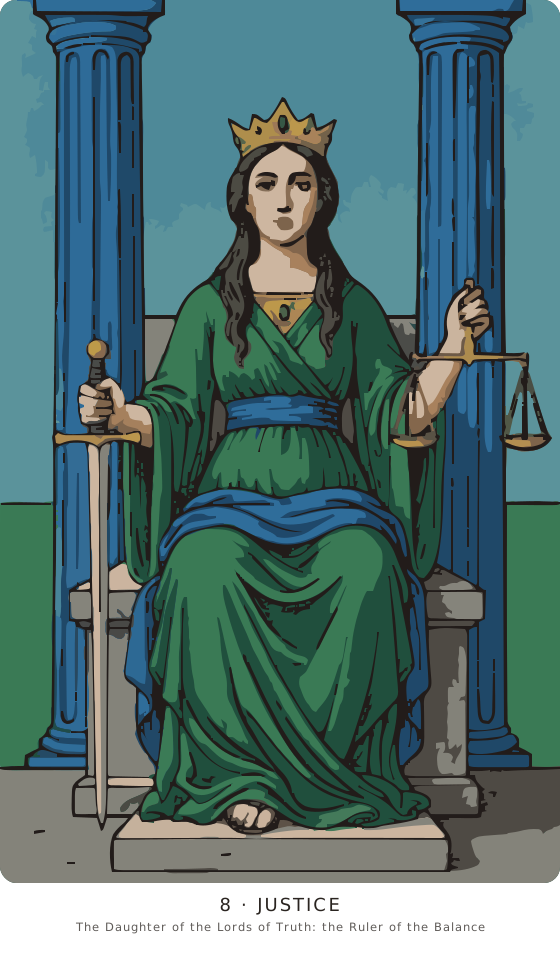 Book T deck, SVG. PlayfulProcess (line art traced from the AI painting). CC-BY-SA-4.0.
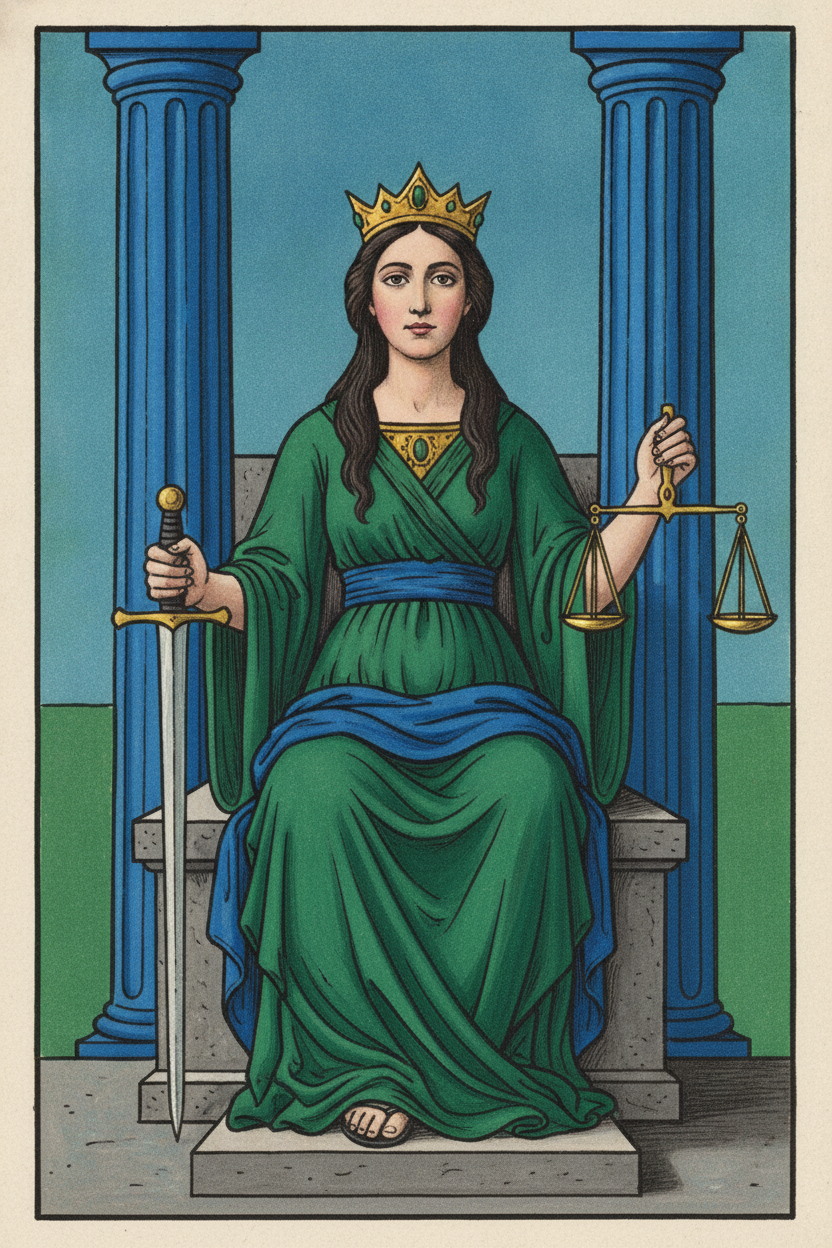 Book T deck, painting. AI painting (gemini-2.5-flash-image) from Book T's words, prompt by PlayfulProcess. CC-BY-SA-4.0.
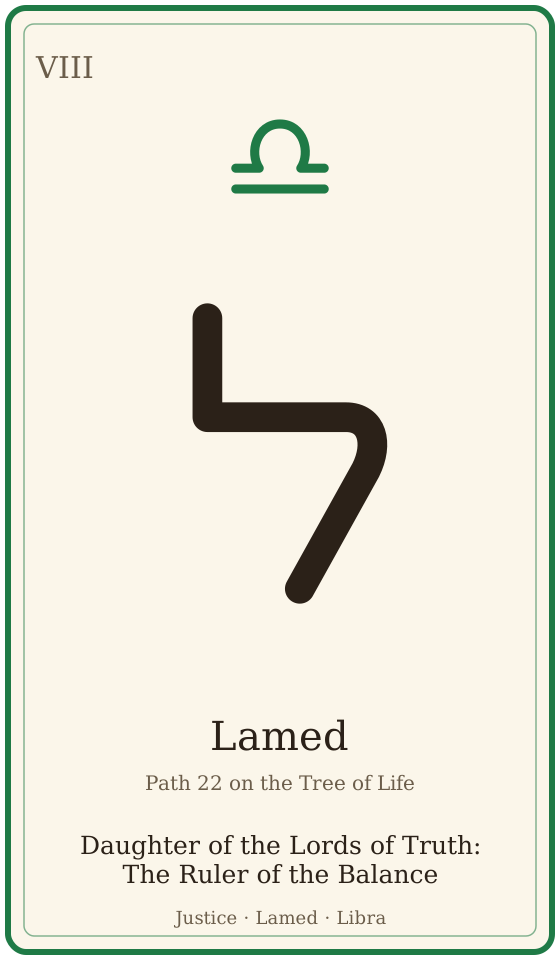 Book T deck, iconography. PlayfulProcess: glyphs drawn for this deck, composed by script (scripts/build_book_t_iconography.py) from the card's own metadata, placed as Book T (1912) places them. CC-BY-SA-4.0.
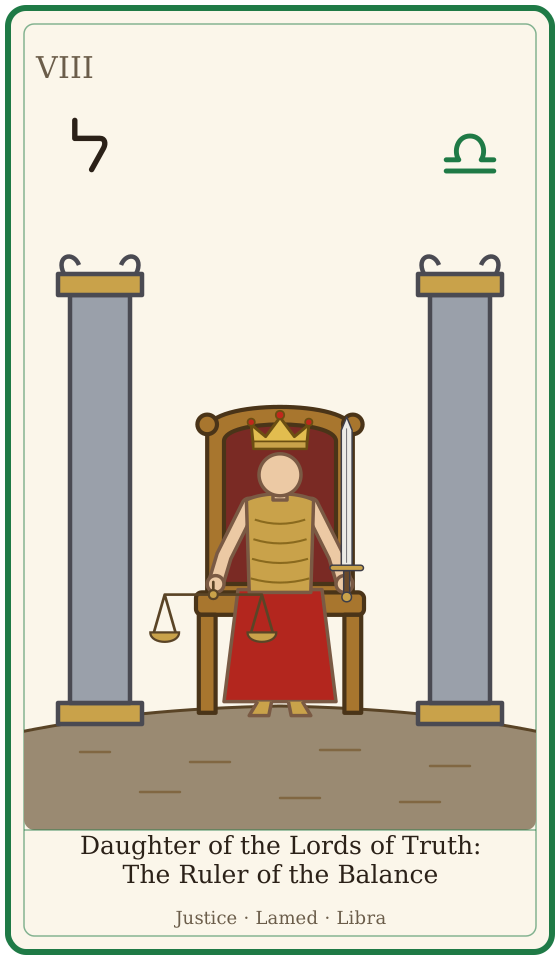 Book T deck, full imagery. PlayfulProcess: parts drawn for this deck (tarot/book-t/parts, tarot/book-t/glyphs), composed by script (scripts/build_book_t_full_imagery.py) from a spec per card that follows Book T (1912). CC-BY-SA-4.0.
 Book T deck, linocut. PlayfulProcess: a linocut printing of the full imagery, composed by script (scripts/build_book_t_linocut.py) from the same spec per card, which follows Book T (1912). CC-BY-SA-4.0.