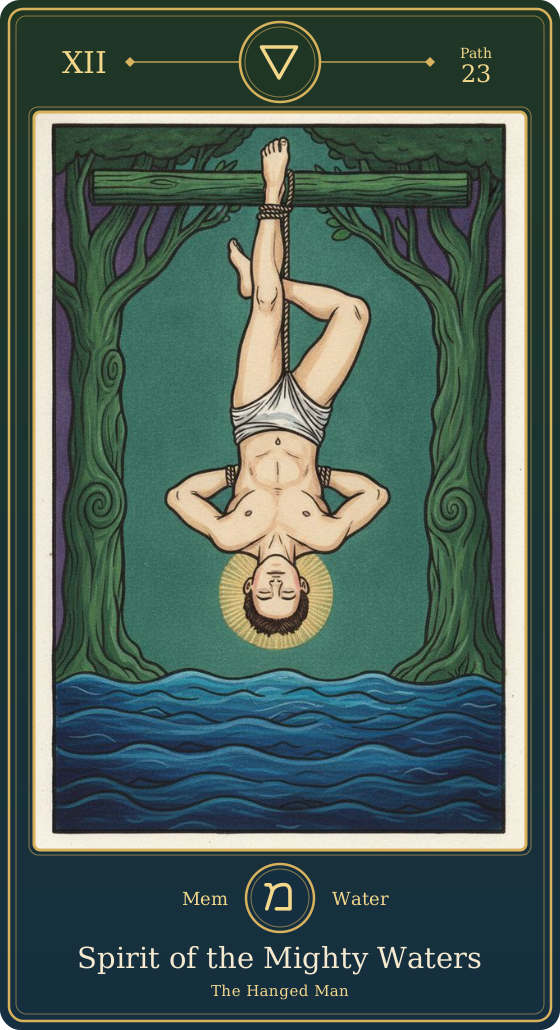
Book T no. 69 · Key 12 · Hebrew letter Mem · Path 23
Spirit of the Mighty Waters
The Hanged Man (Key 12) · The Spirit of the Mighty Waters
Read to know yourself, not to surrender yourself: relate to the card; never obey it.
Book T (1912)
Enforced sacrifice, punishment, loss, fatal and not voluntary, suffering.
Book T as printed in The Equinox I(8), 1912, public domain (notes in square brackets are Crowley's).
In Book T's table
No. 69 of Book T's 78 titles · The Hanged Man, Key 12 · letter מ Mem · Water
Correspondences
Hebrew letter: מ (Mem, 'water') — path 23 on the Tree of Life.
On the Tree: path 23 joins Geburah and Hod · see it on the map
Attribution: Water.
(Classical Golden Dawn / Book T attribution. Modern decks add an outer planet — Uranus, Neptune, or Pluto — to the three elemental trumps.)
Waite, Pictorial Key (1911)
A. E. Waite, a member of the Golden Dawn, in The Pictorial Key to the Tarot (London, 1911) · public domain · he describes the Rider-Waite-Smith picture of this card, not Book T's
The gallows from which he is suspended forms a Tau cross, while the figure— from the position of the legs-forms a fylfot cross. There is a nimbus about the head of the seeming martyr. It should be noted (1) that the tree of sacrifice is living wood, with leaves thereon; (2) that the face expresses deep entrancement, not suffering; (3) that the figure, as a whole, suggests life in suspension, but life and not death. It is a card of profound significance, but all the significance is veiled. One of his
editors suggests that Eliphas Levi did not know the meaning, which is unquestionable—nor did the editor himself. It has been called falsely a card of martyrdom, a card of prudence, a card of the Great Work, a card of duty; but we may exhaust all published interpretations and find only vanity.
I will say very simply on my own part that it expresses the relation, in one of its aspects, between the Divine and the Universe.
He who can understand that the story of his higher nature is imbedded in this symbolism will receive intimations concerning a great awakening that is possible, and will know that after the sacred Mystery of Death there is a glorious Mystery of Resurrection.
Case, Introduction to the Tarot (1920)
Paul Foster Case, in An Introduction to the Study of the Tarot (New York, 1920), Chapter III, on the letter Mem · public domain in the US · the whole booklet
Water: “mother, seed, and root of all minerals”; the first mirror; reproduction; reflected life. Stable Intelligence: “the source of consistency in the numerations”; joins Geburah to Hod.
Picture sets
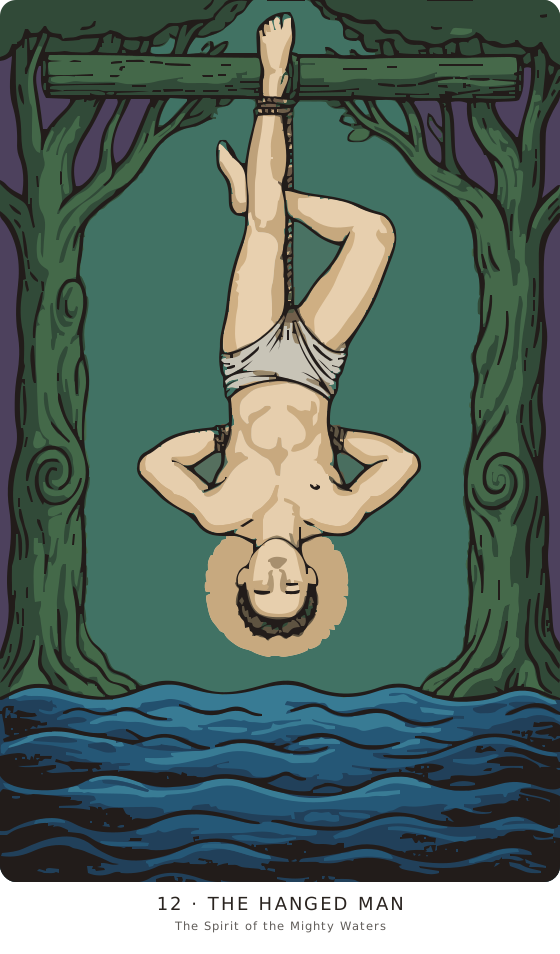 Book T deck, SVG. PlayfulProcess (line art traced from the AI painting). CC-BY-SA-4.0.
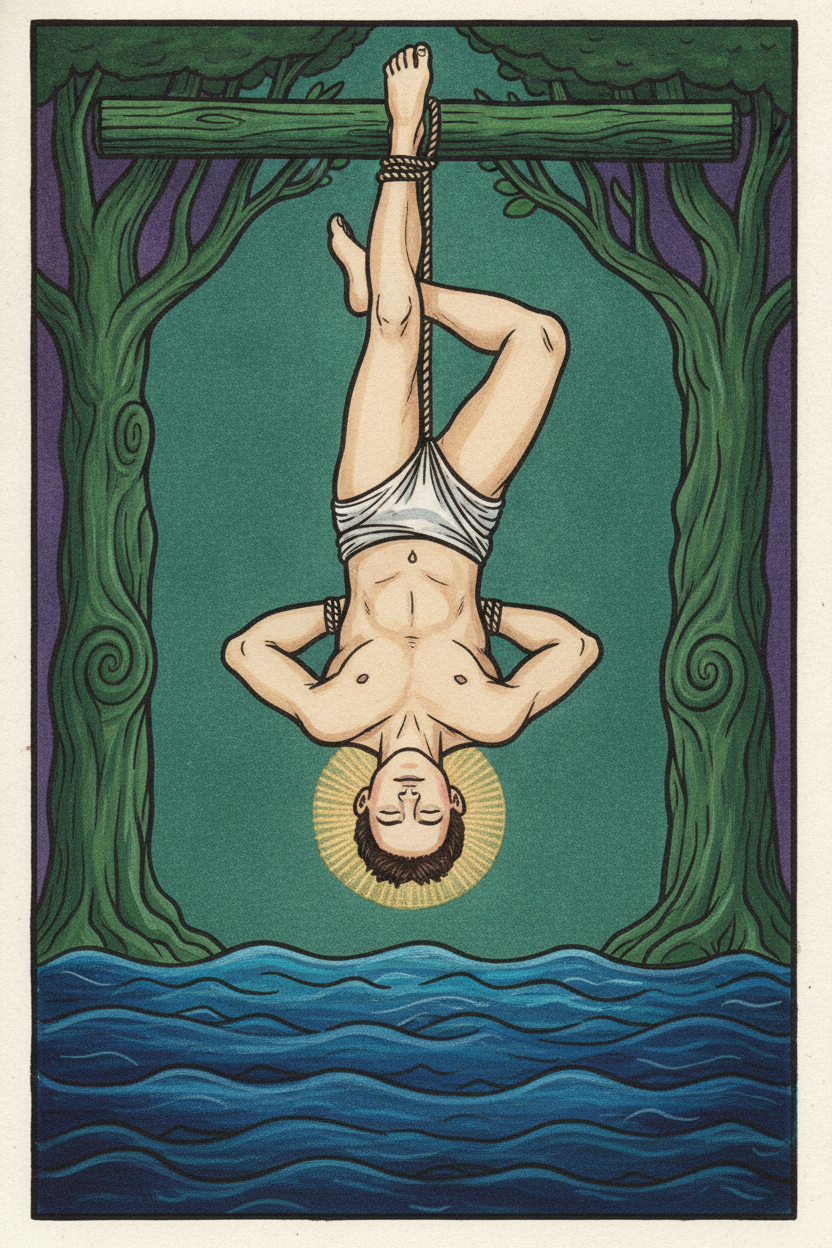 Book T deck, painting. AI painting (gemini-2.5-flash-image) from Book T's words, prompt by PlayfulProcess. CC-BY-SA-4.0.
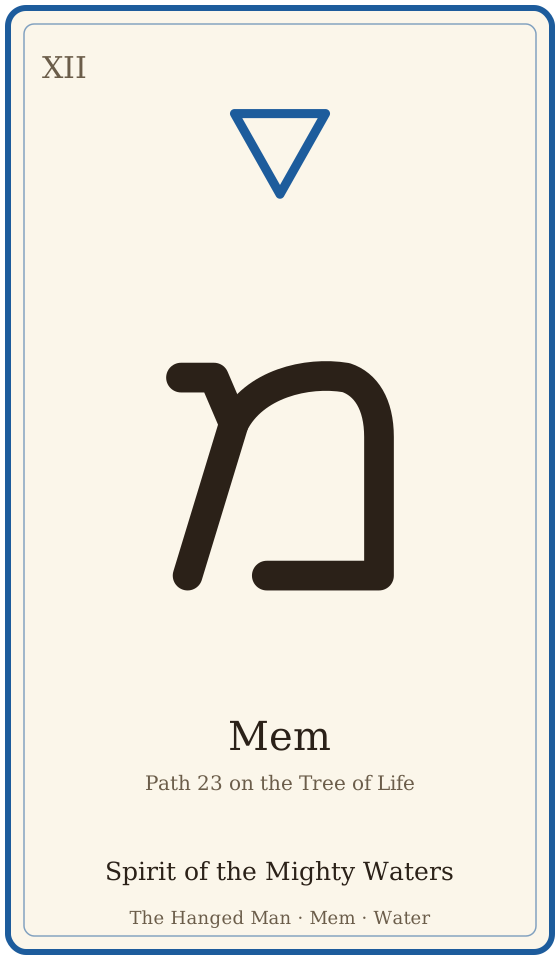 Book T deck, iconography. PlayfulProcess: glyphs drawn for this deck, composed by script (scripts/build_book_t_iconography.py) from the card's own metadata, placed as Book T (1912) places them. CC-BY-SA-4.0.
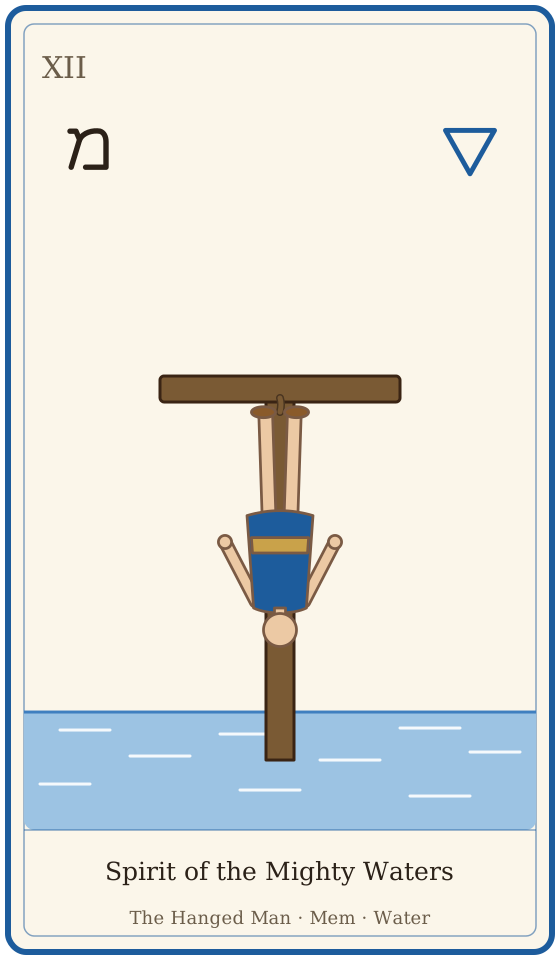 Book T deck, full imagery. PlayfulProcess: parts drawn for this deck (tarot/book-t/parts, tarot/book-t/glyphs), composed by script (scripts/build_book_t_full_imagery.py) from a spec per card that follows Book T (1912). CC-BY-SA-4.0.
 Book T deck, linocut. PlayfulProcess: a linocut printing of the full imagery, composed by script (scripts/build_book_t_linocut.py) from the same spec per card, which follows Book T (1912). CC-BY-SA-4.0.