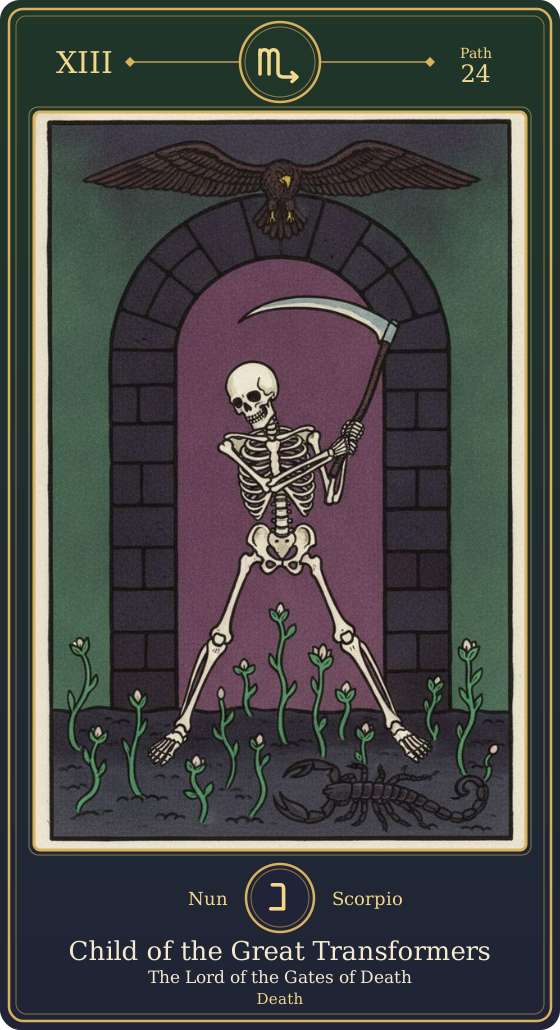
Book T no. 70 · Key 13 · Hebrew letter Nun · Path 24
Child of the Great Transformers: the Lord of the Gates of Death
Death (Key 13) · The Child of the Great Transformers: the Lord of the Gates of Death
Read to know yourself, not to surrender yourself: relate to the card; never obey it.
Book T (1912)
Time, age, transformation, change involuntary (as opposed to 18, Pisces). Or death, destruction (only latter with special cards). [Specially, a sudden and quite unexpected change.]
Book T as printed in The Equinox I(8), 1912, public domain (notes in square brackets are Crowley's).
In Book T's table
No. 70 of Book T's 78 titles · Death, Key 13 · letter נ Nun · Scorpio
Correspondences
Hebrew letter: נ (Nun, 'fish') — path 24 on the Tree of Life.
On the Tree: path 24 joins Tiphareth and Netzach · see it on the map
Attribution: Scorpio.
(Classical Golden Dawn / Book T attribution. Modern decks add an outer planet — Uranus, Neptune, or Pluto — to the three elemental trumps.)
Waite, Pictorial Key (1911)
A. E. Waite, a member of the Golden Dawn, in The Pictorial Key to the Tarot (London, 1911) · public domain · he describes the Rider-Waite-Smith picture of this card, not Book T's
The veil or mask of life is perpetuated in change, transformation and passage from lower to higher, and this is more fitly represented in the rectified Tarot by one of the apocalyptic visions than by the crude notion of the reaping skeleton. Behind it lies the whole world of ascent in the spirit. The mysterious horseman moves slowly, bearing a black banner emblazoned with the Mystic Rose, which signifies life. Between two pillars on the verge of the horizon there shines the sun of immortality. The horseman carries no visible weapon, but king and child and maiden fall before him, while a prelate with clasped hands awaits his end.
There should be no need to point out that the suggestion of death which I have made in connection with the previous card is, of course, to be understood mystically, but this is not the case in the present instance. The natural transit of man to the next stage of his being either is or may be one form of his progress, but the exotic and almost unknown entrance, while still in this life, into the state of mystical death is a change in the form of consciousness and the passage into a state to which ordinary death is neither the path nor gate. The existing occult explanations of the 13th card are, on the whole, better than usual, rebirth, creation, destination, renewal, and the rest.
Case, Introduction to the Tarot (1920)
Paul Foster Case, in An Introduction to the Study of the Tarot (New York, 1920), Chapter III, on the letter Nun · public domain in the US · the whole booklet
Fish: compare Joshua, son of Nun, with Jesus (Joshua), whose sign was that of the prophet Jonah. Early Christians called Jesus Ichthys. This also was the name of a son of Aphrodite. South-west 5 : combines South (Resh) and West (Kaph); opposite of North-east (Vau) ; complement of North-west (Lamed).
Scorpio: nocturnal house of Mars (Peh) ; complement of Aries (Heh), the diurnal house. Motion: all motion is change.
Imaginative Intelligence: joins Tiphareth to Netzach.
(A later editor changed the direction Case gave this letter in 1920; see the booklet's note before quoting it.)
Picture sets
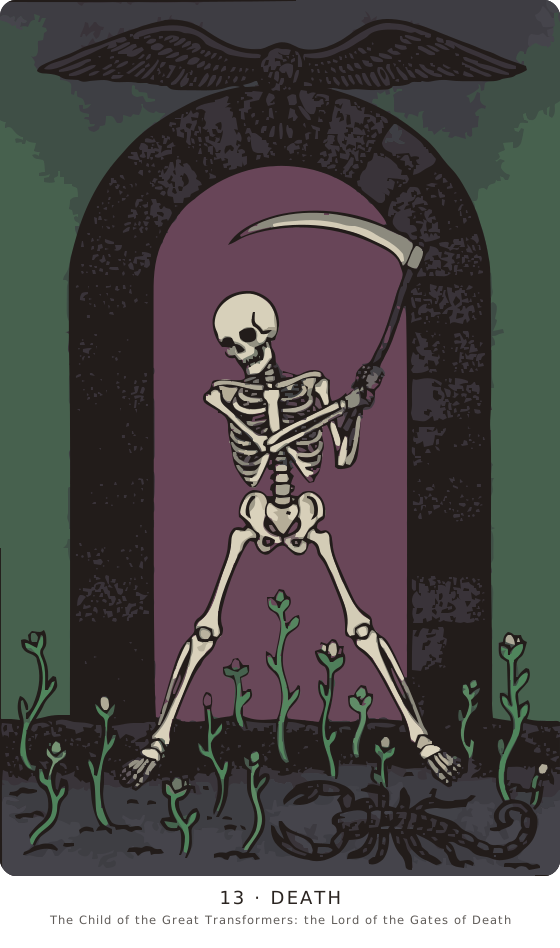 Book T deck, SVG. PlayfulProcess (line art traced from the AI painting). CC-BY-SA-4.0.
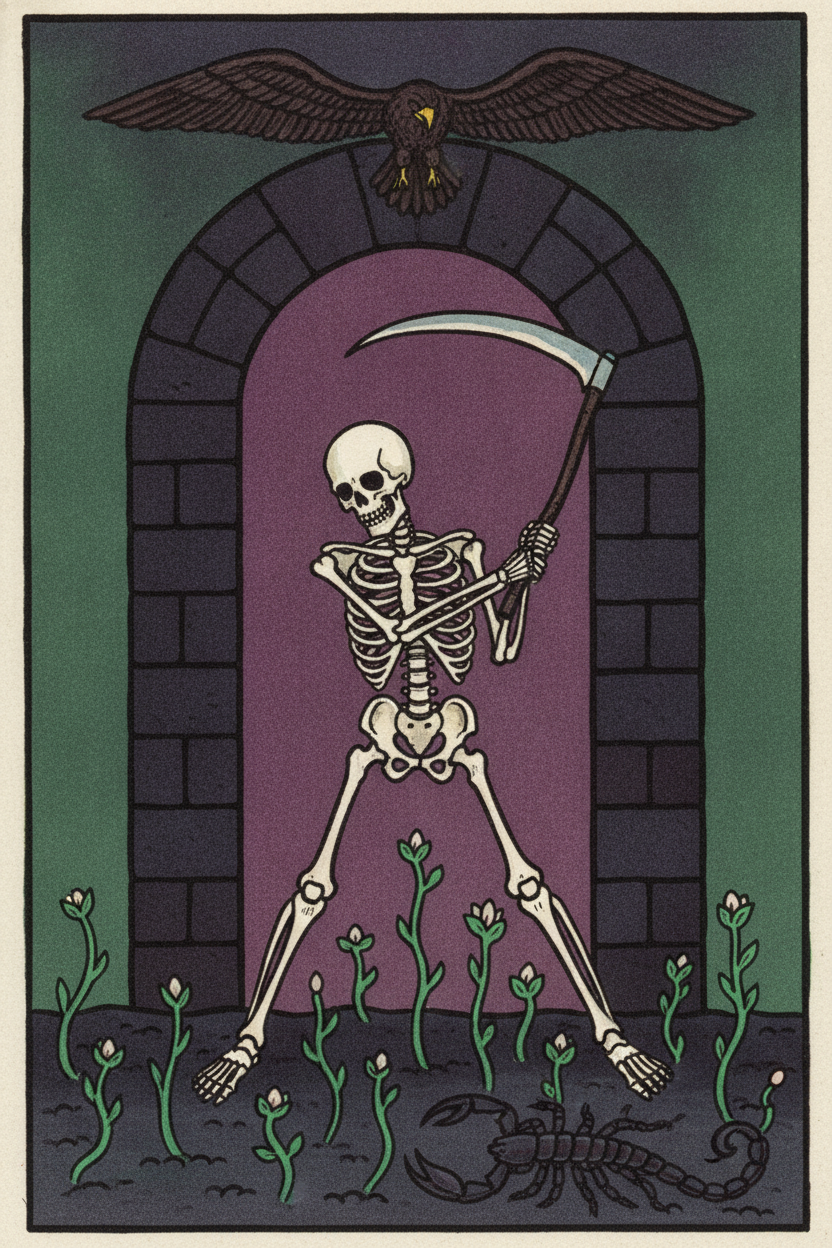 Book T deck, painting. AI painting (gemini-2.5-flash-image) from Book T's words, prompt by PlayfulProcess. CC-BY-SA-4.0.
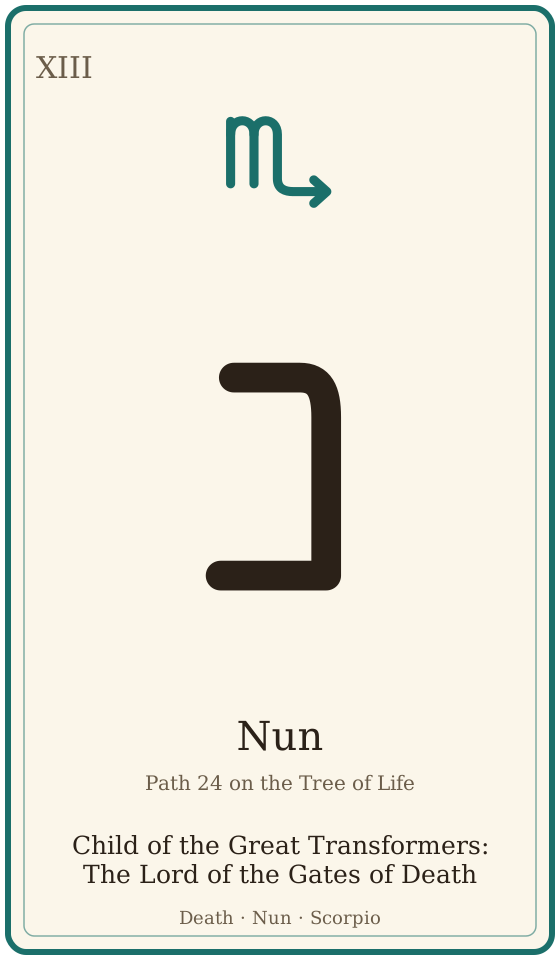 Book T deck, iconography. PlayfulProcess: glyphs drawn for this deck, composed by script (scripts/build_book_t_iconography.py) from the card's own metadata, placed as Book T (1912) places them. CC-BY-SA-4.0.
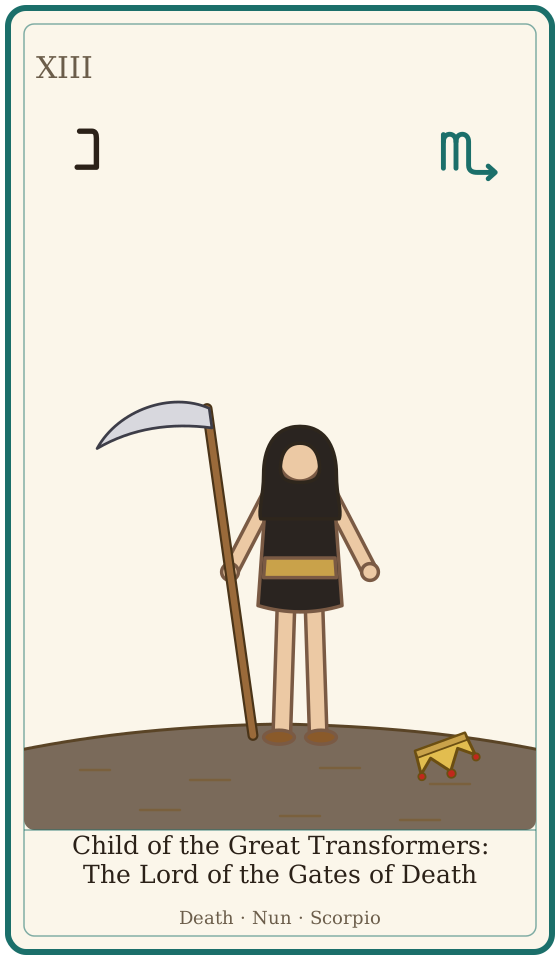 Book T deck, full imagery. PlayfulProcess: parts drawn for this deck (tarot/book-t/parts, tarot/book-t/glyphs), composed by script (scripts/build_book_t_full_imagery.py) from a spec per card that follows Book T (1912). CC-BY-SA-4.0.
 Book T deck, linocut. PlayfulProcess: a linocut printing of the full imagery, composed by script (scripts/build_book_t_linocut.py) from the same spec per card, which follows Book T (1912). CC-BY-SA-4.0.