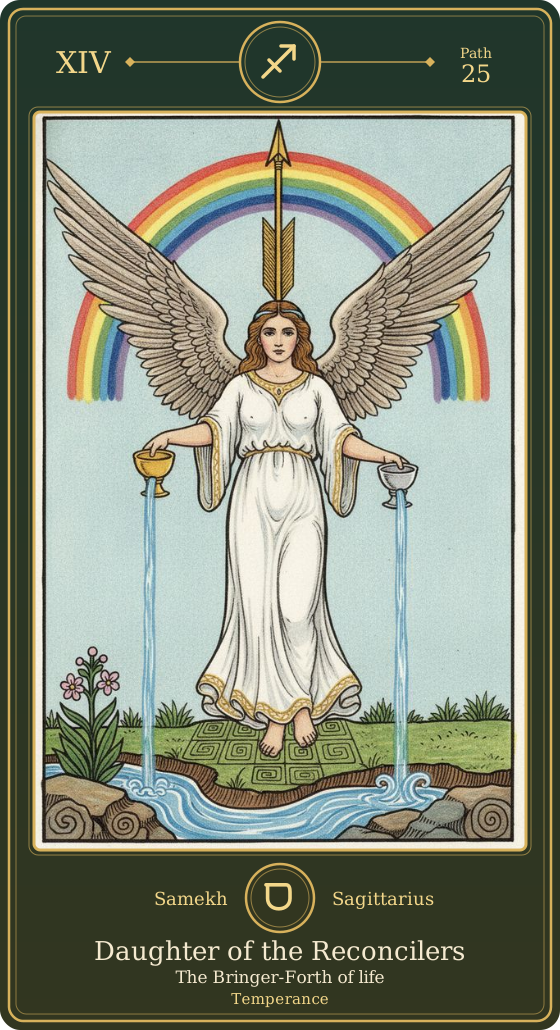
Book T no. 71 · Key 14 · Hebrew letter Samekh · Path 25
Daughter of the Reconcilers: the Bringer-Forth of life
Temperance (Key 14) · The Daughter of the Reconcilers: the Bringer-Forth of life
Read to know yourself, not to surrender yourself: relate to the card; never obey it.
Book T (1912)
Combination of forces, realization, action (material effect, good or evil).
Book T as printed in The Equinox I(8), 1912, public domain (notes in square brackets are Crowley's).
In Book T's table
No. 71 of Book T's 78 titles · Temperance, Key 14 · letter ס Samekh · Sagittarius
Correspondences
Hebrew letter: ס (Samekh, 'prop') — path 25 on the Tree of Life.
On the Tree: path 25 joins Tiphareth and Yesod · see it on the map
Attribution: Sagittarius.
(Classical Golden Dawn / Book T attribution. Modern decks add an outer planet — Uranus, Neptune, or Pluto — to the three elemental trumps.)
Waite, Pictorial Key (1911)
A. E. Waite, a member of the Golden Dawn, in The Pictorial Key to the Tarot (London, 1911) · public domain · he describes the Rider-Waite-Smith picture of this card, not Book T's
A winged angel, with the sign of the sun upon his forehead and on his breast the square and triangle of the septenary. I speak of him in the masculine sense, but the figure is neither male nor female. It is held to be pouring the essences of life from chalice to chalice. It has one foot upon the earth and one upon waters, thus illustrating the nature of the essences. A direct path goes up to certain heights on the verge of the horizon, and above there is a great light, through which a crown is seen vaguely. Hereof is some part of the Secret of Eternal Life, as it is possible to man in his incarnation. All the conventional emblems are renounced herein.
So also are the conventional meanings, which refer to changes in the seasons, perpetual movement of life and even the combination of ideas. It is, moreover, untrue to say that the figure symbolizes the genius of the sun, though it is the analogy of solar light, realized in the third part of our human triplicity. It is called Temperance fantastically, because, when the rule of it obtains in our consciousness, it tempers, combines and harmonises the psychic and material natures. Under that rule we know in our rational part something of whence we came and whither we are going.
Case, Introduction to the Tarot (1920)
Paul Foster Case, in An Introduction to the Study of the Tarot (New York, 1920), Chapter III, on the letter Samekh · public domain in the US · the whole booklet
Prop: support, assistance; improvement, refinement, purification.
West-above: combines West (Kaph) and Above (Beth); opposite of East-above (Zain); complement of West-below (Ayin).
Sagittarius: diurnal house of Jupiter (Kaph) ; complement of Pisces (Qoph), the nocturnal house.
> Note 5. Paul Case in 1920 attributed Lamed to South-West and Nun to North-West but later upon further research, changed these attributions. These have been changed in the text to accord with his later findings. Ed.
Wrath: in Greek, thumos, desire or appetite; akin to the Rajas of Hindu philosophy. Tentative Intelligence: joins Tiphareth to Yesod.
Picture sets
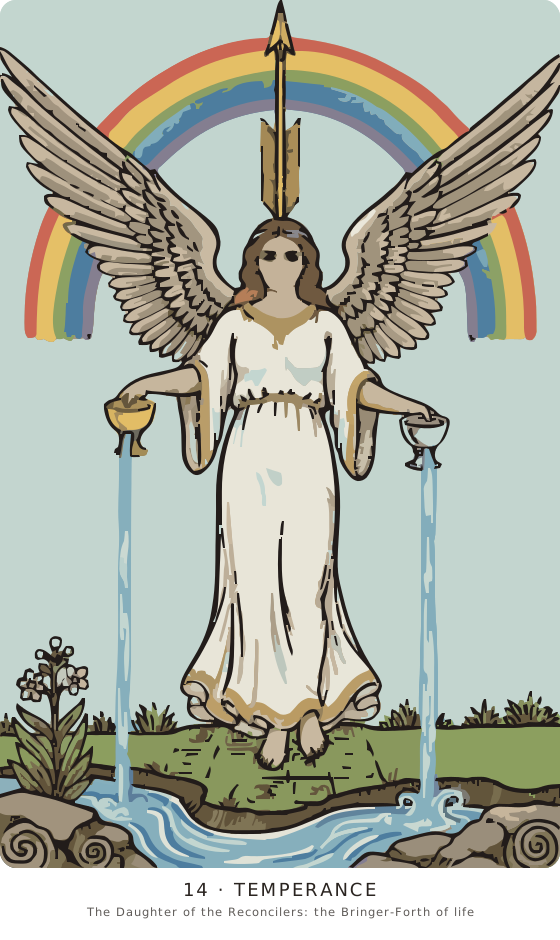 Book T deck, SVG. PlayfulProcess (line art traced from the AI painting). CC-BY-SA-4.0.
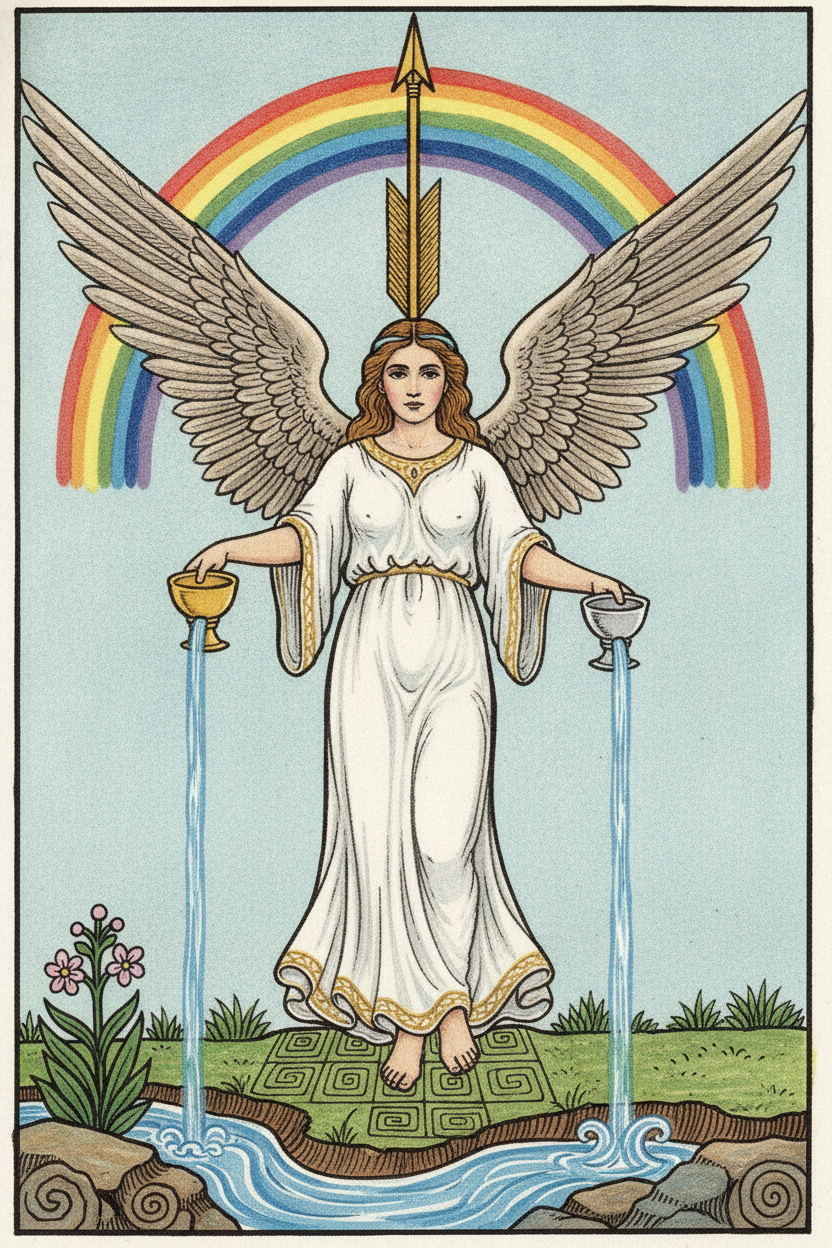 Book T deck, painting. AI painting (gemini-2.5-flash-image) from Book T's words, prompt by PlayfulProcess. CC-BY-SA-4.0.
 Book T deck, iconography. PlayfulProcess: glyphs drawn for this deck, composed by script (scripts/build_book_t_iconography.py) from the card's own metadata, placed as Book T (1912) places them. CC-BY-SA-4.0.
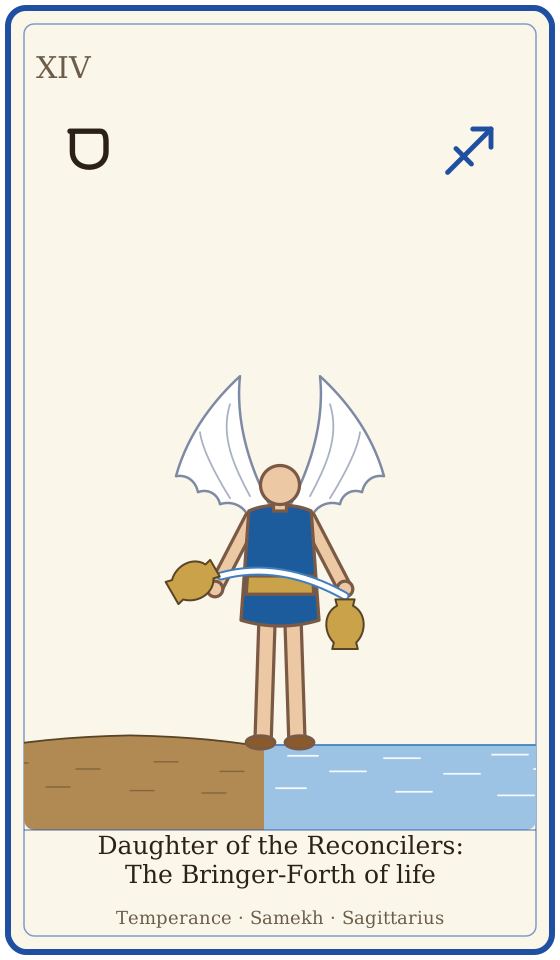 Book T deck, full imagery. PlayfulProcess: parts drawn for this deck (tarot/book-t/parts, tarot/book-t/glyphs), composed by script (scripts/build_book_t_full_imagery.py) from a spec per card that follows Book T (1912). CC-BY-SA-4.0.
 Book T deck, linocut. PlayfulProcess: a linocut printing of the full imagery, composed by script (scripts/build_book_t_linocut.py) from the same spec per card, which follows Book T (1912). CC-BY-SA-4.0.