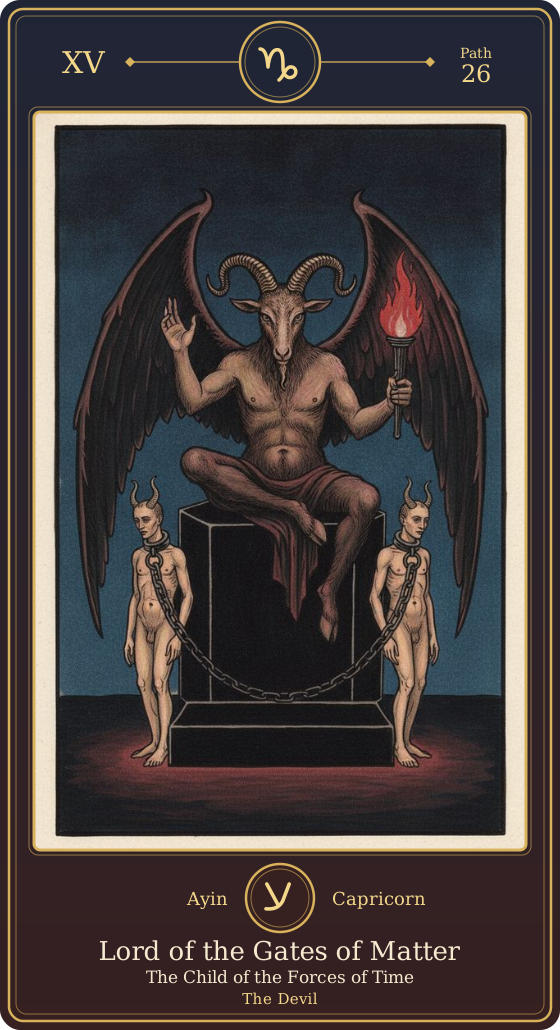
Book T no. 72 · Key 15 · Hebrew letter Ayin · Path 26
Lord of the Gates of Matter: the Child of the Forces of Time
The Devil (Key 15) · The Lord of the Gates of Matter: the Child of the Forces of Time
Read to know yourself, not to surrender yourself: relate to the card; never obey it.
Book T (1912)
Materiality, material force, material temptation, obsession.
Book T as printed in The Equinox I(8), 1912, public domain (notes in square brackets are Crowley's).
In Book T's table
No. 72 of Book T's 78 titles · The Devil, Key 15 · letter ע Ayin · Capricorn
Correspondences
Hebrew letter: ע (Ayin, 'eye') — path 26 on the Tree of Life.
On the Tree: path 26 joins Tiphareth and Hod · see it on the map
Attribution: Capricorn.
(Classical Golden Dawn / Book T attribution. Modern decks add an outer planet — Uranus, Neptune, or Pluto — to the three elemental trumps.)
Waite, Pictorial Key (1911)
A. E. Waite, a member of the Golden Dawn, in The Pictorial Key to the Tarot (London, 1911) · public domain · he describes the Rider-Waite-Smith picture of this card, not Book T's
The design is an accommodation, mean or harmony, between several motives mentioned in the first part. The Horned Goat of Mendes, with wings like those of a bat, is standing on an altar. At the pit of the stomach there is the sign of Mercury. The right hand is upraised and extended, being the reverse of that benediction which is given by the Hierophant in the fifth card. In the left hand there is a great flaming torch, inverted towards the earth. A reversed pentagram is on the forehead. There is a ring in front of the altar, from which two chains are carried to the necks of two figures, male and female. These are analogous with those of the fifth card, as if Adam and Eve after the Fall. Hereof is the chain and fatality of the material life.
The figures are tailed, to signify the animal nature, but there is human intelligence in the faces, and he who is exalted above them is not to be their master for ever. Even now, he is also a bondsman, sustained by the evil that is in him and blind to the liberty of service. With more than his usual
derision for the arts which he pretended to respect and interpret as a master therein, Eliphas Levi affirms that the Baphometic figure is occult science and magic. Another commentator says that in the Divine world it signifies predestination, but there is no correspondence in that world with the things which below are of the brute. What it does signify is the Dweller on the Threshold without the Mystical Garden when those are driven forth therefrom who have eaten the forbidden fruit.
Case, Introduction to the Tarot (1920)
Paul Foster Case, in An Introduction to the Study of the Tarot (New York, 1920), Chapter III, on the letter Ayin · public domain in the US · the whole booklet
Eye: the instrument of vision; orb; circle; limitation; bondage; appearances, Avidya. Laughter: usually caused by incongruity; human weaknesses, distress, and pain furnish the elements of comedy.
West-below: combines West (Kaph) and Below (Gimel); opposite of East-below (Cheth) ; complement of West-above (Samekh).
Capricorn: nocturnal house of Saturn (Tau) ; complement of Aquarius (Tzaddi), the diurnal house. Renewing Intelligence: joins Tiphareth to Hod.
Picture sets
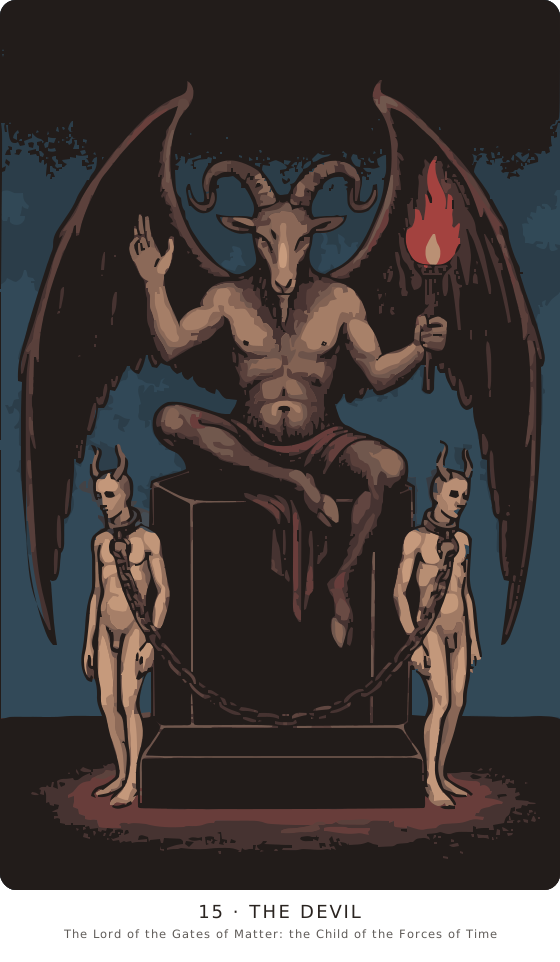 Book T deck, SVG. PlayfulProcess (line art traced from the AI painting). CC-BY-SA-4.0.
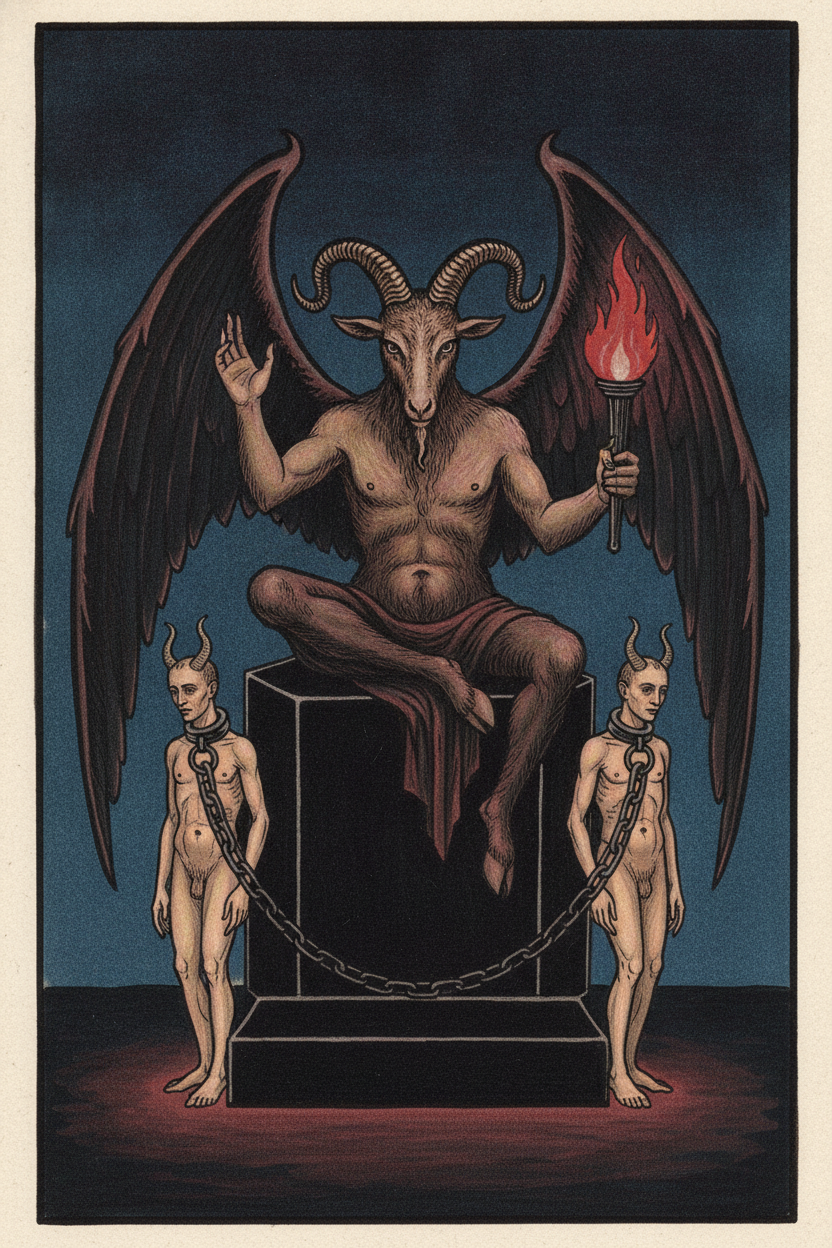 Book T deck, painting. AI painting (gemini-2.5-flash-image) from Book T's words, prompt by PlayfulProcess. CC-BY-SA-4.0.
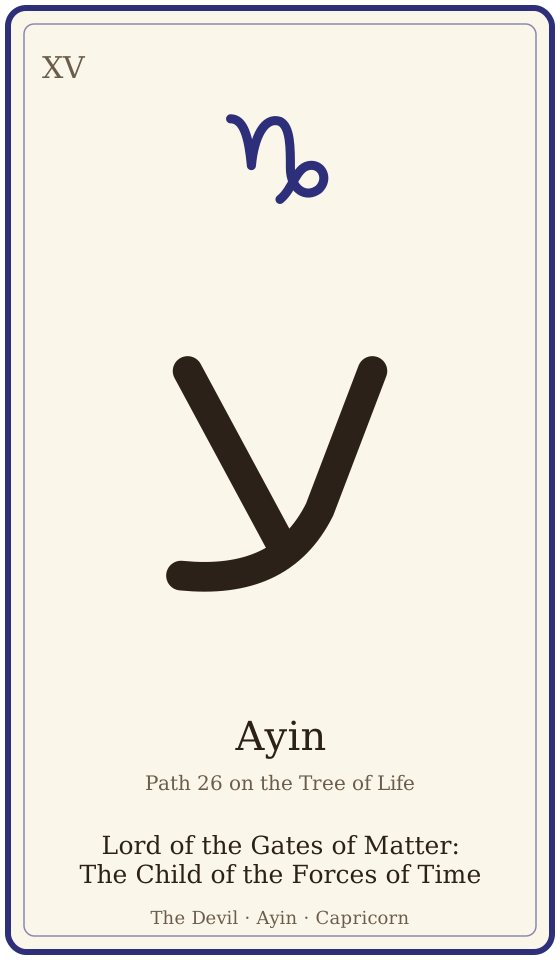 Book T deck, iconography. PlayfulProcess: glyphs drawn for this deck, composed by script (scripts/build_book_t_iconography.py) from the card's own metadata, placed as Book T (1912) places them. CC-BY-SA-4.0.
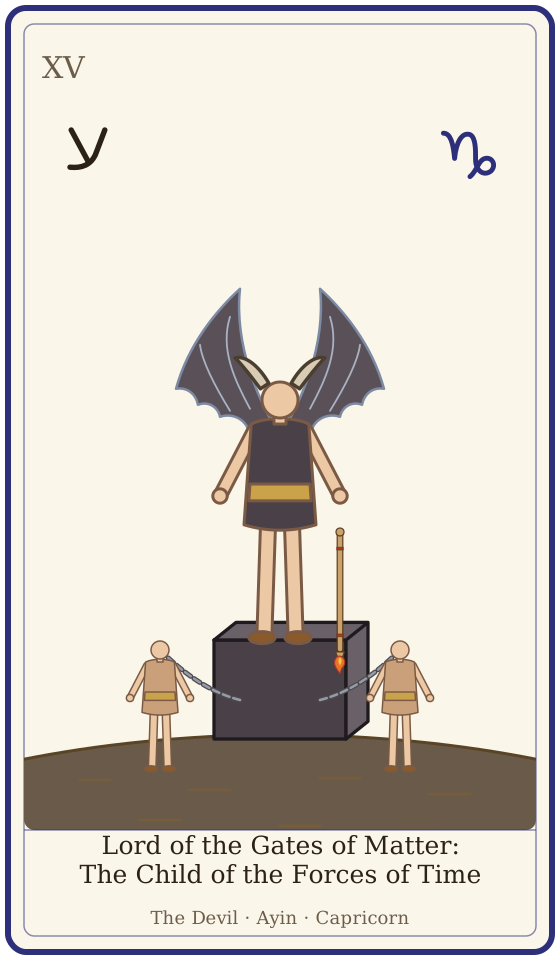 Book T deck, full imagery. PlayfulProcess: parts drawn for this deck (tarot/book-t/parts, tarot/book-t/glyphs), composed by script (scripts/build_book_t_full_imagery.py) from a spec per card that follows Book T (1912). CC-BY-SA-4.0.
 Book T deck, linocut. PlayfulProcess: a linocut printing of the full imagery, composed by script (scripts/build_book_t_linocut.py) from the same spec per card, which follows Book T (1912). CC-BY-SA-4.0.