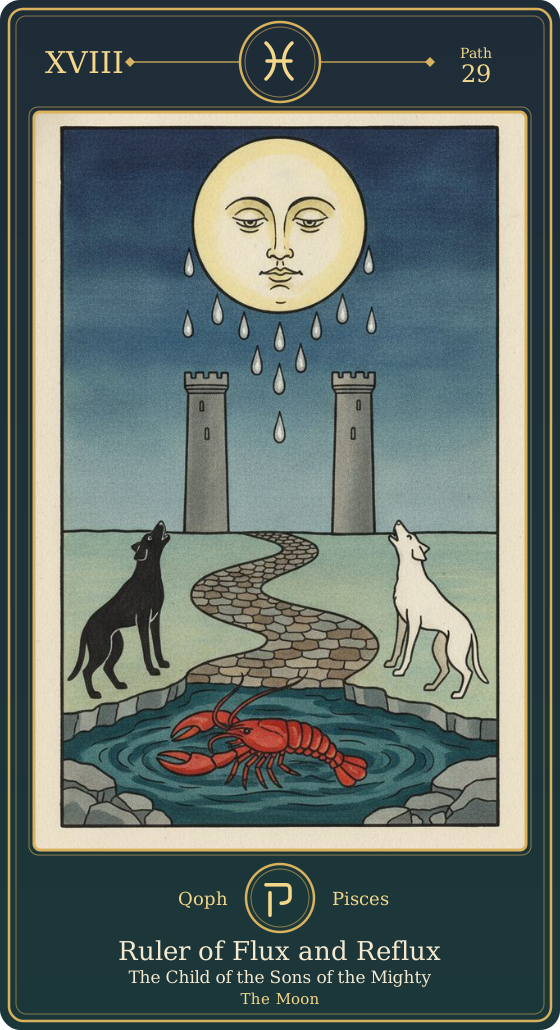
Book T no. 75 · Key 18 · Hebrew letter Qoph · Path 29
Ruler of Flux and Reflux: the Child of the Sons of the Mighty
The Moon (Key 18) · The Ruler of Flux and Reflux: the Child of the Sons of the Mighty
Read to know yourself, not to surrender yourself: relate to the card; never obey it.
Book T (1912)
Dissatisfaction, voluntary change. Error, lying, falsity, deception. This card is very sensitive to dignity.
Book T as printed in The Equinox I(8), 1912, public domain (notes in square brackets are Crowley's).
In Book T's table
No. 75 of Book T's 78 titles · The Moon, Key 18 · letter ק Qoph · Pisces
Correspondences
Hebrew letter: ק (Qoph, 'back of head') — path 29 on the Tree of Life.
On the Tree: path 29 joins Netzach and Malkuth · see it on the map
Attribution: Pisces.
(Classical Golden Dawn / Book T attribution. Modern decks add an outer planet — Uranus, Neptune, or Pluto — to the three elemental trumps.)
Waite, Pictorial Key (1911)
A. E. Waite, a member of the Golden Dawn, in The Pictorial Key to the Tarot (London, 1911) · public domain · he describes the Rider-Waite-Smith picture of this card, not Book T's
The distinction between this card and some of the conventional types is that the moon is increasing on what is called the side of mercy, to the right of the observer. It has sixteen chief and sixteen secondary rays. The card represents life of the imagination apart from life of the spirit. The path between the towers is the issue into the unknown. The dog and wolf are the fears of the natural mind in the presence of that place of exit, when there is only reflected light to guide it.
The last reference is a key to another form of symbolism. The intellectual light is a reflection and beyond it is the unknown mystery which it cannot shew forth. It illuminates our animal nature, types of which are represented below-the dog, the wolf and that which comes up out of the deeps, the nameless and hideous tendency which is lower than the savage beast. It strives to attain manifestation, symbolized by crawling from the abyss of water to the land, but as a rule it sinks back whence it came. The face of the mind directs a calm gaze upon the unrest below; the dew of thought falls; the message is: Peace, be still; and it may be that there shall come a calm upon the animal nature, while the abyss beneath shall cease from giving up a form.
Case, Introduction to the Tarot (1920)
Paul Foster Case, in An Introduction to the Study of the Tarot (New York, 1920), Chapter III, on the letter Qoph · public domain in the US · the whole booklet
Back of head, or knot: location of medulla oblongata, which forms a knot on the spinal cord near the nape of the neck. It controls or greatly influences many functions which make it directly responsible for the maintenance of bodily life.
South-below: combines South (Resh) and Below (Gimel); opposite of North-below (Yod) ; complement of South-above (Tzaddi).
Sleep: period of physiological repair, during which nerve substance undergoes the subtle changes that make the advancing student of occultism ready to experience and understand facts, concealed from ordinary men, which are the basis of the ancient wisdom.
Pisces: nocturnal house of Jupiter (Kaph) ; complement of Sagittarius (Samekh), the diurnal house. Corporeal Intelligence: joins Netzach to Malkuth.
Picture sets
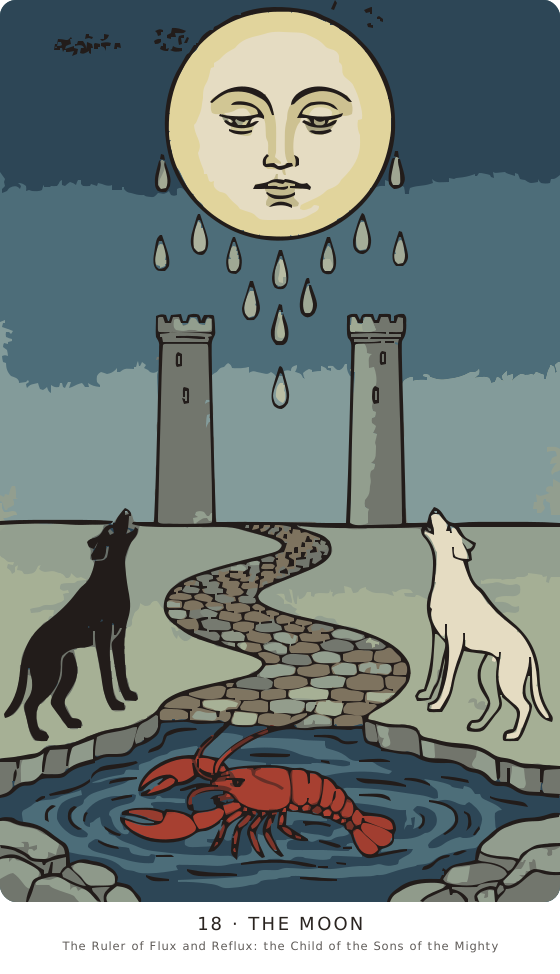 Book T deck, SVG. PlayfulProcess (line art traced from the AI painting). CC-BY-SA-4.0.
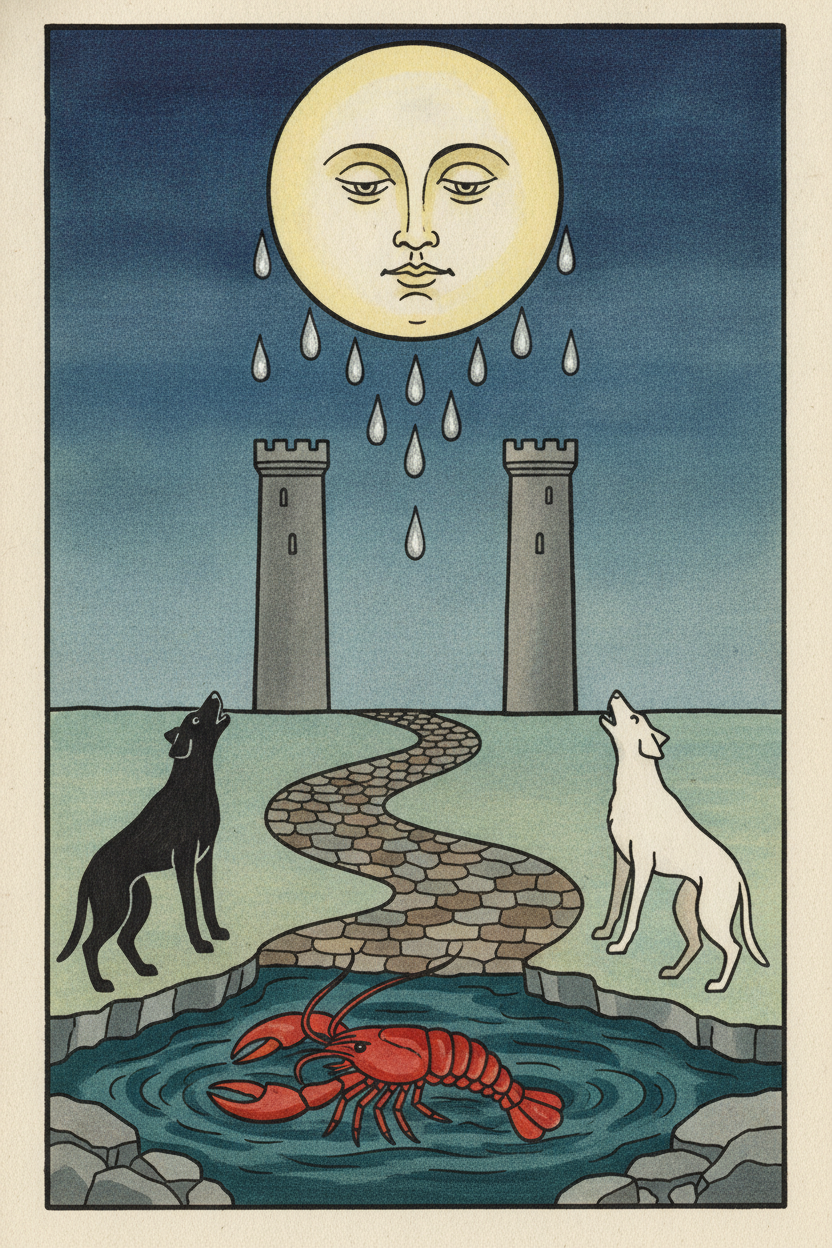 Book T deck, painting. AI painting (gemini-2.5-flash-image) from Book T's words, prompt by PlayfulProcess. CC-BY-SA-4.0.
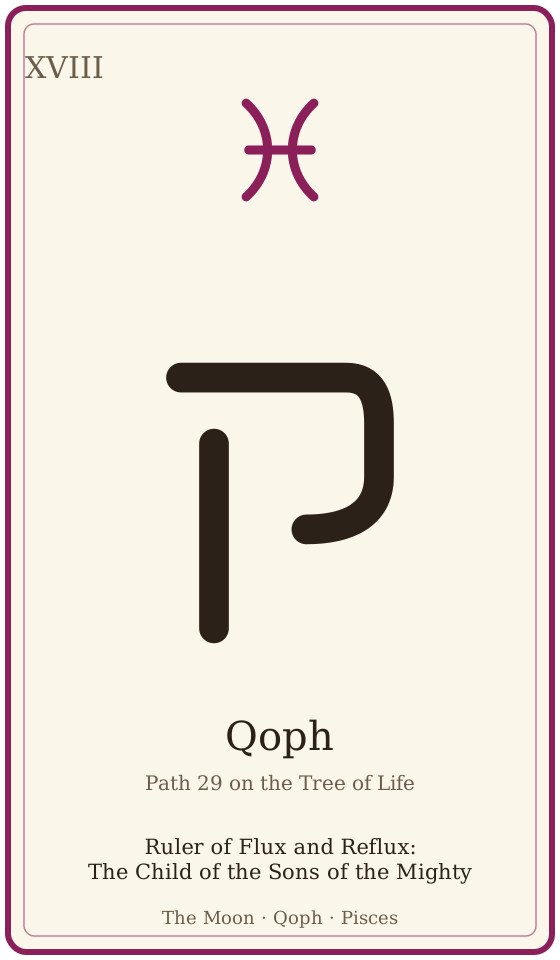 Book T deck, iconography. PlayfulProcess: glyphs drawn for this deck, composed by script (scripts/build_book_t_iconography.py) from the card's own metadata, placed as Book T (1912) places them. CC-BY-SA-4.0.
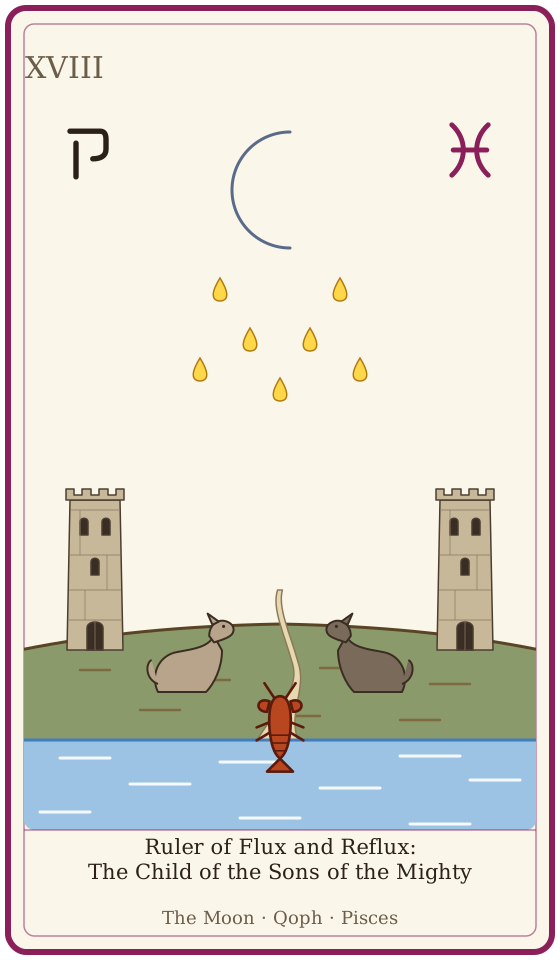 Book T deck, full imagery. PlayfulProcess: parts drawn for this deck (tarot/book-t/parts, tarot/book-t/glyphs), composed by script (scripts/build_book_t_full_imagery.py) from a spec per card that follows Book T (1912). CC-BY-SA-4.0.
 Book T deck, linocut. PlayfulProcess: a linocut printing of the full imagery, composed by script (scripts/build_book_t_linocut.py) from the same spec per card, which follows Book T (1912). CC-BY-SA-4.0.