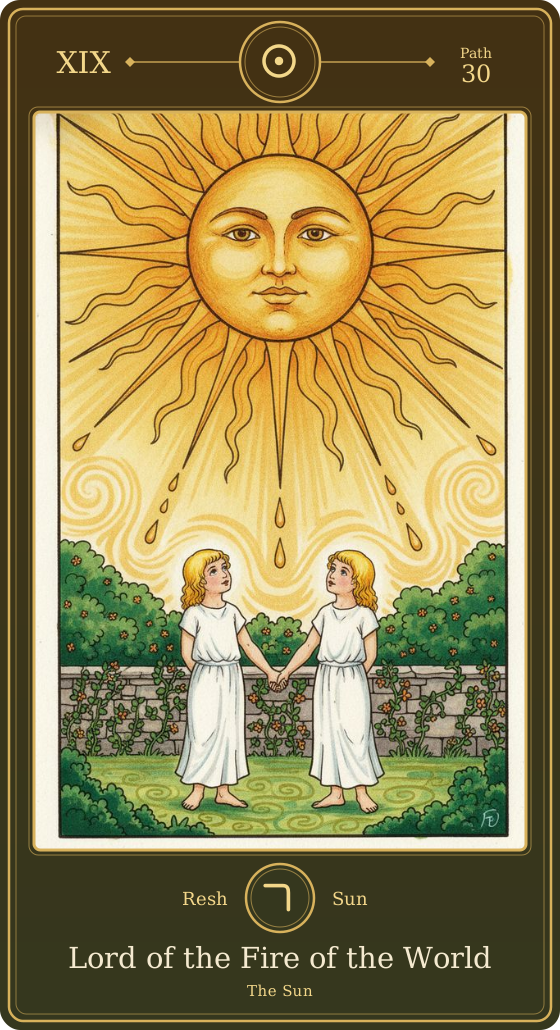
Book T no. 76 · Key 19 · Hebrew letter Resh · Path 30
Lord of the Fire of the World
The Sun (Key 19) · The Lord of the Fire of the World
Read to know yourself, not to surrender yourself: relate to the card; never obey it.
Book T (1912)
Glory, gain, riches. With "very" evil cards it means arrogance, display, vanity.
Book T as printed in The Equinox I(8), 1912, public domain (notes in square brackets are Crowley's).
In Book T's table
No. 76 of Book T's 78 titles · The Sun, Key 19 · letter ר Resh · Sun
Correspondences
Hebrew letter: ר (Resh, 'head') — path 30 on the Tree of Life.
On the Tree: path 30 joins Hod and Yesod · see it on the map
Attribution: the Sun.
(Classical Golden Dawn / Book T attribution. Modern decks add an outer planet — Uranus, Neptune, or Pluto — to the three elemental trumps.)
Waite, Pictorial Key (1911)
A. E. Waite, a member of the Golden Dawn, in The Pictorial Key to the Tarot (London, 1911) · public domain · he describes the Rider-Waite-Smith picture of this card, not Book T's
The naked child mounted on a white horse and displaying a red standard has been mentioned already as the better symbolism connected with this card. It is the destiny of the Supernatural East and the great and holy light which goes before the endless procession of humanity, coming out from the walled garden of the sensitive life and passing on the journey home. The card signifies, therefore, the transit from the manifest light of this world, represented by the glorious sun of earth, to the light of the world to come, which goes before aspiration and is typified by the heart of a child.
But the last allusion is again the key to a different form or aspect of the symbolism. The sun is that of consciousness in the spirit - the direct as the antithesis of the reflected light. The characteristic type of humanity has become a little child therein— a child in the sense of simplicity and innocence in the sense of wisdom. In that simplicity, he bears the seal of Nature and of Art; in that innocence, he signifies the restored world. When the self-knowing spirit has dawned in the consciousness above the natural mind, that mind in its renewal leads forth the animal nature in a state of perfect conformity.
Case, Introduction to the Tarot (1920)
Paul Foster Case, in An Introduction to the Study of the Tarot (New York, 1920), Chapter III, on the letter Resh · public domain in the US · the whole booklet
Head, or face: guiding power, organizer, director; the face is the countenance, from the Latin continere, to hold together, to repress, to contain.
South: place of sun at his meridian height; opposite of North (Peh). Sun: rules Leo (Teth) day and night.
Fruitfulness and Sterility: extremes of the manifestation of solar energy. The sun causes all growth, and is also the maker of waste places.
Collecting Intelligence: joins Hod to Yesod. Note the correspondence between collecting and countenance.
Picture sets
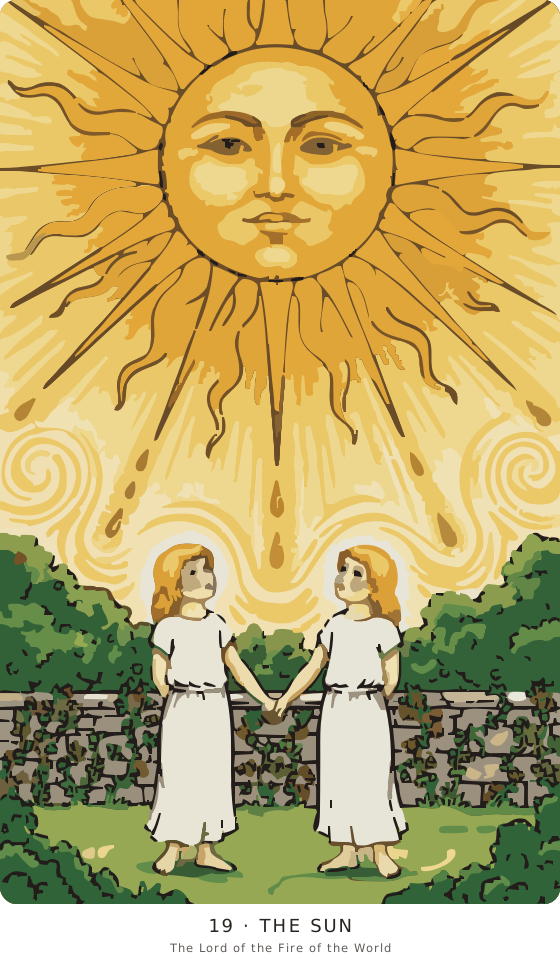 Book T deck, SVG. PlayfulProcess (line art traced from the AI painting). CC-BY-SA-4.0.
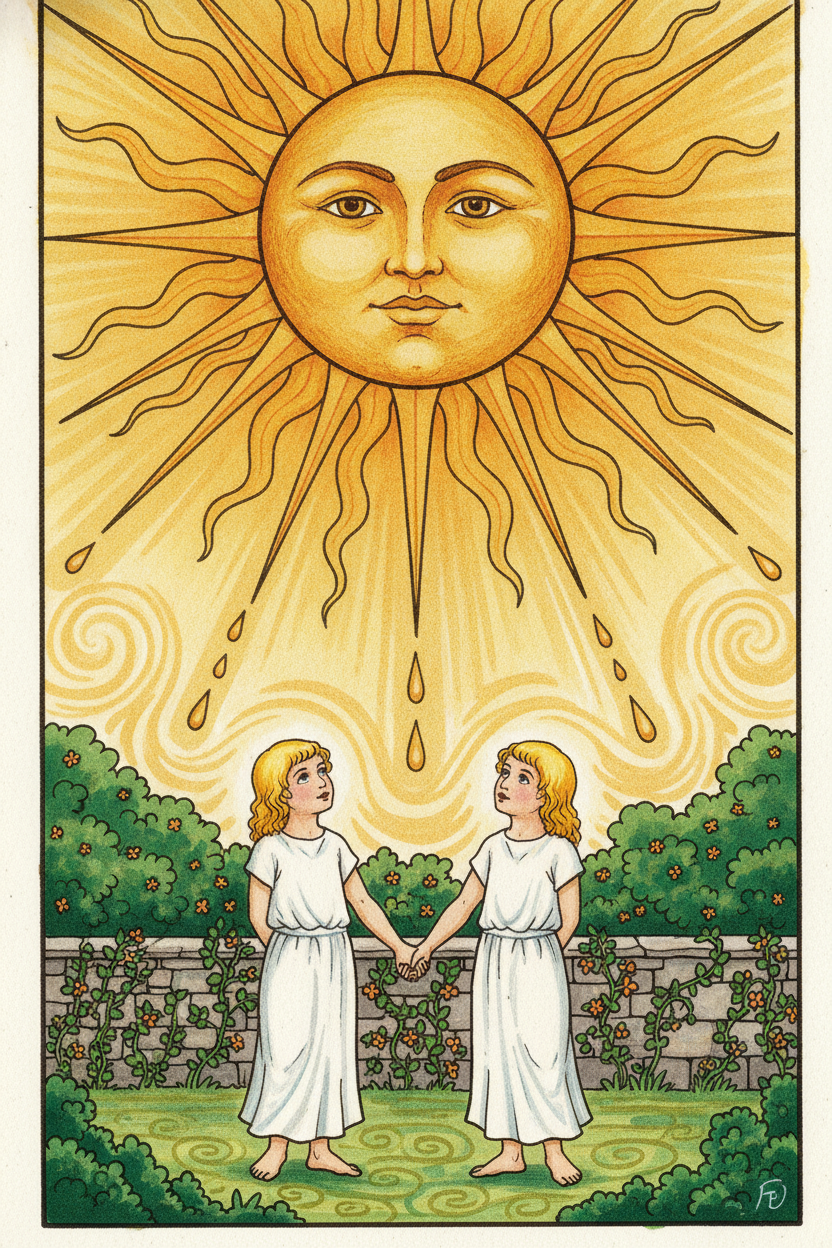 Book T deck, painting. AI painting (gemini-2.5-flash-image) from Book T's words, prompt by PlayfulProcess. CC-BY-SA-4.0.
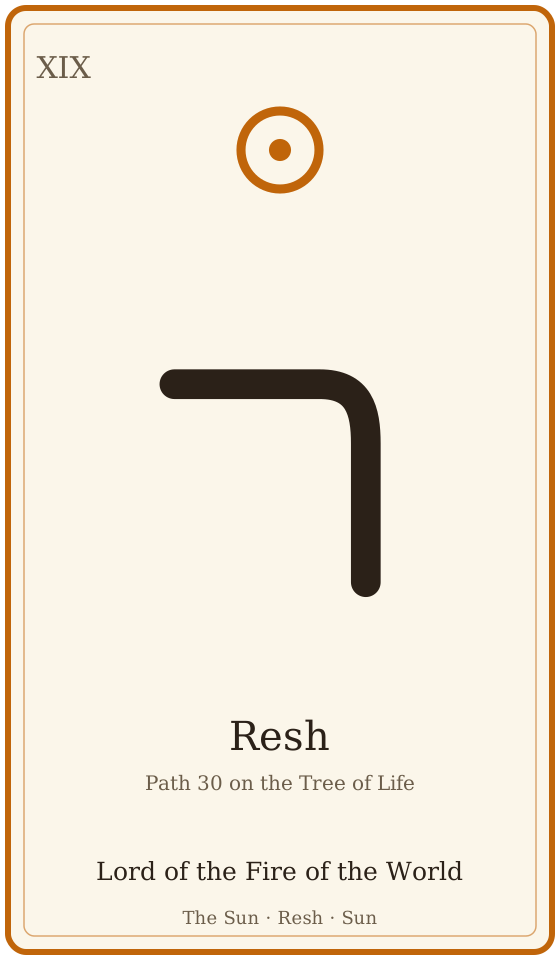 Book T deck, iconography. PlayfulProcess: glyphs drawn for this deck, composed by script (scripts/build_book_t_iconography.py) from the card's own metadata, placed as Book T (1912) places them. CC-BY-SA-4.0.
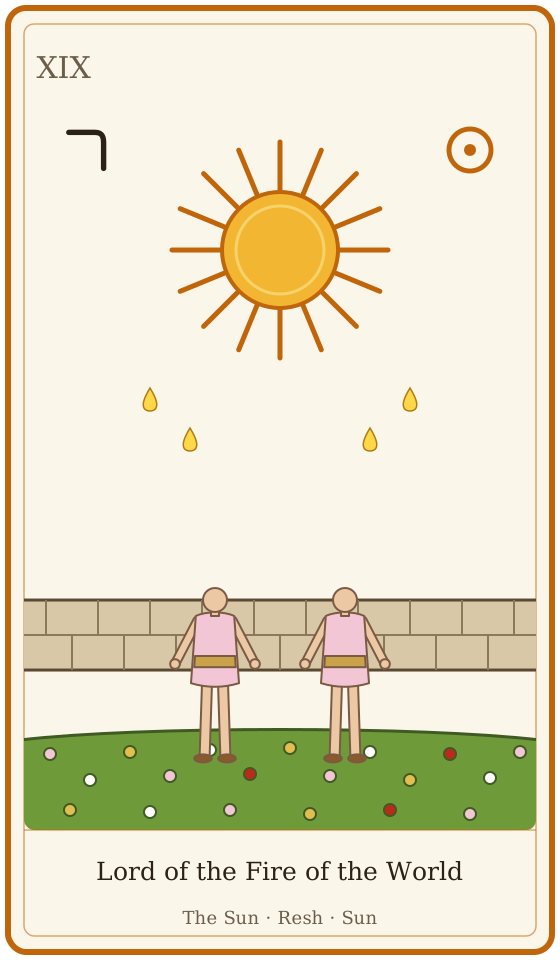 Book T deck, full imagery. PlayfulProcess: parts drawn for this deck (tarot/book-t/parts, tarot/book-t/glyphs), composed by script (scripts/build_book_t_full_imagery.py) from a spec per card that follows Book T (1912). CC-BY-SA-4.0.
 Book T deck, linocut. PlayfulProcess: a linocut printing of the full imagery, composed by script (scripts/build_book_t_linocut.py) from the same spec per card, which follows Book T (1912). CC-BY-SA-4.0.