About this library
The work so far
An open, unfinished study — offered in the hope that human hands make it better.
The Recursive Tarot is the work so far of one solo developer — PlayfulProcess — who is passionate about the tarot and about the wider family of meaning-making systems, and who built this library with a great deal of help from AI. It is published in the open, deliberately unfinished, because the hope is simple: that real human collaborators — historians, readers, artists, translators, scholars — will come and make the whole thing better.
I am a student of these cards and traditions, not an authority on them. The historical notes are a careful first pass, kept close to the documentary record (Dummett's spine), but they will contain mistakes — and those mistakes are mine alone.
Where I cite the Tarot History Forum or other scholarship, I cite them only as sources I learned from — never as reviewers who vouch for this catalogue. They are not responsible for my errors. If you know better than I do, corrections are genuinely welcome — here's how to contribute.
Spiritual gossip
I have a long-standing interest in oracles and spirituality. I love what I call spiritual gossip, and I really wanted to believe the tarot was a spiritual revelation from Hermes Trismegistus.
Learning it was a fiction stirred a lot in me. Learning that people like Waite knew it was a fiction, and still thought he was receiving authoritative instructions on a right way to read the tarot, stirred even more. I don't want to fall into the same mistake.
I feel tarot is a cultural phenomenon. It can be used for beauty and introspection: a dialogue that can help us see patterns in our lives, even if it does not predict the future.
One branch of a larger tree
This site is a branch of recursive.eco — an open platform built on grammars: symbolic systems you make meaning with, made by people, not algorithms. A tarot deck is one such grammar. This library is what a single grammar looks like when it grows all the way out: its history, its scholarship, its per-card research.
A logo, still forming
Manifesto
The Recursive Tarot
A living grammar, held in the open.
We begin with an observation. The history of tarot is not a history of fixed meanings handed down intact. It is a history of people renewing, over and over, their relationship with one small set of symbols.
That renewal is not a corruption of the tradition. It is the tradition.
We hold tarot to be a living grammar — a finite alphabet of images that can speak an unending number of sentences. Like any living language, it survives only because people keep speaking it in new ways. Every deck is a dialect. Every spread, a sentence someone dares to propose. Every reading, a small act of interpretation. Each generation receives the language, bends it, and hands it on.
And here is the older truth the legends were reaching for. Tolkien argued that the invented worlds — the fairy-stories, the myths — are not an escape from reality but one of the ways we return to it. We are, he said, sub-creators: born into a world we did not make, and invited, even so, to take part in its making. We paint and tell stories and invent games and plant gardens and build languages and dream up worlds — not because the world is lacking, but because imagining is one of the ways we belong to it.
He gave one of imagination's gifts a name: Recovery — the grace of seeing the ordinary again as if for the first time. The sun has lit every day we have ever lived, and feeds the whole green weight of the earth, and still we stop seeing it; small wonder some once knelt to it as Apollo, only to look again. A tree becomes "just a tree." A beloved face disappears into habit. Recovery is the quiet miracle of attention restored — and it is not sentimentality.
We have an old phrase for this kind of seeing — rose-colored glasses — and we usually mean it as an insult, a soft lie laid over the truth. It may be closer to the opposite. Studying dating couples across a year, the psychologists Sandra Murray, John Holmes, and Dale Griffin found that the partners who idealized each other — who kept noticing what was alive and good in the other — were not the deluded ones but the ones whose love lasted, and whose generous view tended, over time, to come true: love, they found, is not blind but prescient. That is not a refusal to see reality. It is a discipline for seeing more of it. And in a way, that is what tarot can be: a pair of glasses we put on to look again — not to gild the world, but to recover the good, the strange, and the possible that habit had worn smooth.
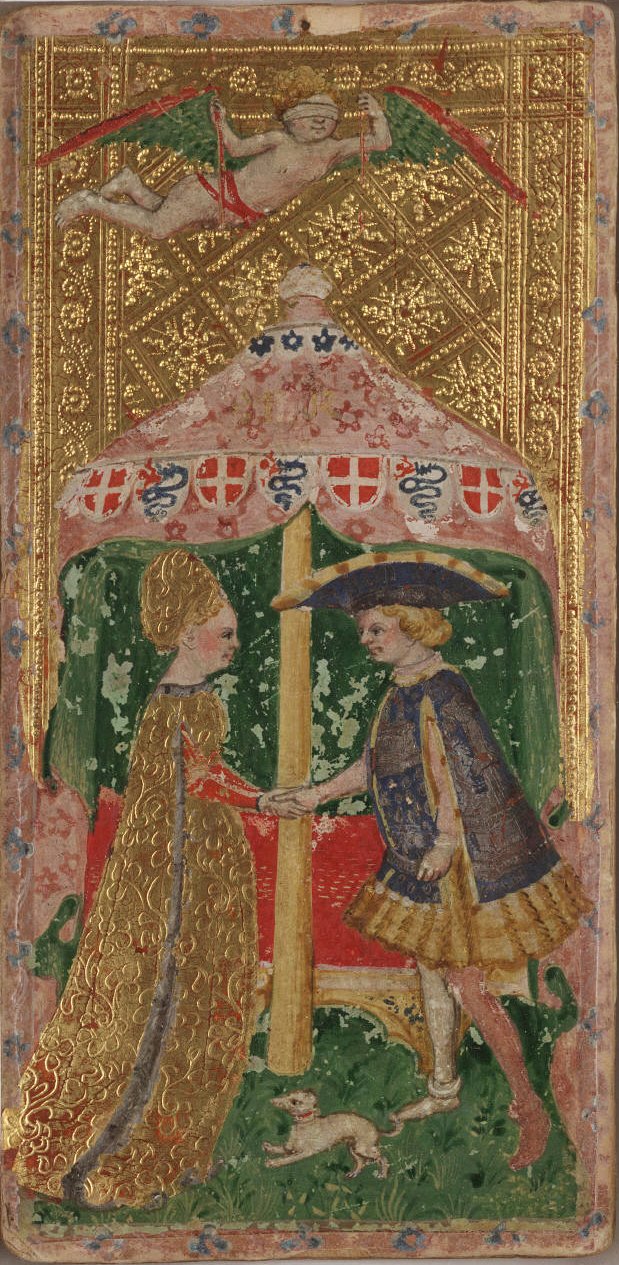
This is what the cards can be, at their best: a small practice of recovery. Not because they hold hidden powers, and not because some ancient civilisation knew a magic we have lost — but because a shuffled image interrupts our habits of seeing. It asks us to pause. To notice. To imagine that things might be otherwise. So the card is a mirror, never a verdict. Relate to it; do not obey it. A card stops being an oracle of what will be and becomes a gate onto what is already alive in you, and onto the futures you might help bring about. Not a fate. A gate. Meaning here is not merely discovered; it is cultivated, through participation.
This is an old shape, and an honest one. The scholar of nondual Shaiva Tantra Christopher Wallis describes his own path as a kind of circle: you take up the view first and practice it, and only then does the recognition it promised begin to arrive — the doing and the seeing co-create one another. So it is here. You do not wait until you believe to read the cards; the way of seeing they offer is something you build by doing it.
Perhaps that is why people keep returning. Not because tarot ever decoded the secret of things — but because the mystery is never quite decoded, and the cards are a way to dance with it. Every generation inherits these symbols, sees something new in them, and leaves them a little changed for the next.
And it has rarely been a solitary thing. One old line of thought — running through Durkheim and the myth-and-ritual scholars — held that the deepest purpose of any mythology was social: that its apex was the moment it gathered people into a shared rite, and a reading shared between two people is that gathering in miniature.
Our task, then, is not to recover the one true tarot; there is no such thing. It is to understand how this grammar has actually grown, why it keeps inviting hands, and how to add to it honestly.
Honesty, for us, has a shape. We keep the historical decks not because they are sacred but because they are a shared inheritance, and we let each tradition speak in its own voice: we name the artist and the year, we do not dress a fifteenth-century card game in occult meanings it never wore, and we keep the record of what happened apart from the practices built upon it. Mostly, responsibility is a refusal to flatten — letting a Marseille deck be a Marseille deck and a Golden Dawn deck be a Golden Dawn deck, without pretending either is the secret key to the other.
This is why the work is open. Every deck here is open data and open code — readable, correctable, translatable, free to fork. The living grammar is the idea; the open commons is the practice that makes the idea true. A tradition you cannot touch is not alive; it is embalmed.
And so it is an invitation.
Study the old decks. Learn how they differ. Watch meanings rise, drift, vanish, and return. Then make something of your own. Some will build private decks for their families; others for classrooms, communities, research, games, therapy, poetry, or some purpose no one has yet tried. Some will collaborate. Some will publish. Some will keep alive a tradition that might otherwise be lost. Each one continues the same human practice — inheriting symbols, transforming them through experience, and offering them back.
The software exists only to serve that. Here you can make cards, build symbolic grammars, document their history, argue their meanings, work alongside others, and — if you wish — publish your work as an open project the next people can carry on. The aim was never to generate images. It is to tend a living tradition.
Recursive Tarot is one grammar within the wider ecosystem of recursive.eco. We believe symbolic systems deserve the care we already give to open software, to shared science, to living ecosystems: they flourish when they are documented, questioned, maintained, shared, and renewed by communities — not when they are guarded by authorities. The future of tarot belongs to no single school, publisher, or philosophy. It belongs to everyone willing to meet it honestly, playfully, and generously.
The invitation is not to uncover a final meaning sealed inside the cards. It is to join the long human practice of tending a symbolic language — one image, one conversation, one act of imagination at a time.
That same argument — that meaning is made, not found, and that the making is where the responsibility lives — became a book too: Tarot as a Doorway into the Mythical World, which follows it further out: into scripture, diagnosis, national myth, the reading engine behind every feed. The library and the book are the same argument, worked at two different scales.
Three doors lead on from here: trace the renewal in The History of Tarot; learn to hold the cards — as a mirror, not a fate — in Reading the Cards; and add your own to the commons in Ways to Contribute.
The archive is not complete. The grammar is not finished. The conversation continues.Welcome.